Bots and Collusion in Poker Apps: How to Spot Them and Protect Yourself
In club poker apps the shuffle is rarely the problem — the people at the table can be. Teams sharing cards, one player running three accounts, software playing instead of a human: these are the cheats that actually cost players money. Here’s how each one works, what it looks like from your seat, what the apps do against it and what you can do yourself.
Updated: 16 October 2026
Key takeaways
The main threats are collusion (players working together), multi-accounting, bots and real-time assistants.
Cheating leaves patterns: the same players always together, folds that only make sense with extra information, robotic timing.
ClubGG checks accounts for bots and shared IP, GPS and devices, and clubs can turn on GPS / IP restriction on tables.
Your best defence is the club: choose clubs that answer reports and ban cheaters, and report with hand numbers.
4main types of cheating: collusion, multi-accounting, bots, RTA
IP · GPSwhat ClubGG checks to link accounts
1account per person in every app
0third-party HUDs needed in ClubGG — Smart HUD is built in
What counts as cheating in poker apps
Every app and serious club bans the same things. Some hurt you directly at the table; others give one player an edge no one else can have.
CollusionTwo or more players share hole cards in a chat or call, soft-play each other and gang up on everyone else.
Chip dumpingOne player deliberately loses chips to another — to move money, launder a bonus or build up a partner.
Multi-accountingOne person runs several accounts, sometimes at the same table — effectively colluding with themselves.
BotsSoftware that plays without a human, often on many tables and around the clock.
Real-time assistantsSolvers or helper programs that tell a human what to do during the hand. Banned in ClubGG and most serious clubs.
GhostingA stronger player takes over someone else’s account or advises them live during a session.
How collusion works at the table
Colluders win in two ways: they know more cards than you, and they bet together to push you out of pots. Two partners at a 6-max table see four cards instead of two before the flop — that alone changes many decisions.
Shared infohole cards in a chat or call
Squeezeraise and re-raise around you
You foldor pay too much to see a card
The team winsthe pot goes to either of them
A typical “whipsaw” play by two colluders
A whipsaw is when two partners raise and re-raise with you caught in the middle, forcing you to call several bets or give up your equity. The opposite pattern — never betting into each other, checking down hands they’d bet against anyone else — is soft-play, and it’s just as telling.
Warning signs of collusion and bots
Collusion
The same two or three accounts always sit at your table, and join or leave together.
They almost never raise each other, but often raise and re-raise when you’re in the pot.
One of them folds a strong hand exactly when the other has the nuts.
Big pots between them look one-sided: one player keeps losing to the other in odd spots.
They’re always seated in positions that sandwich you.
Bots and real-time assistance
Play around the clock with no breaks and no change in style.
The same timing for every decision, whether the spot is trivial or difficult.
Fixed, solver-like bet sizes in every situation.
Never chats, never uses emojis, never reacts — not proof, but part of the picture.
Long tank in trivial spots and instant actions in complex ones — typical of someone waiting for a helper program.
One sign proves nothing. Strong regulars also play long sessions with consistent sizing, and friends sometimes play the same tables. Look for several signs together, over many hands.
GPS and IP restriction explained
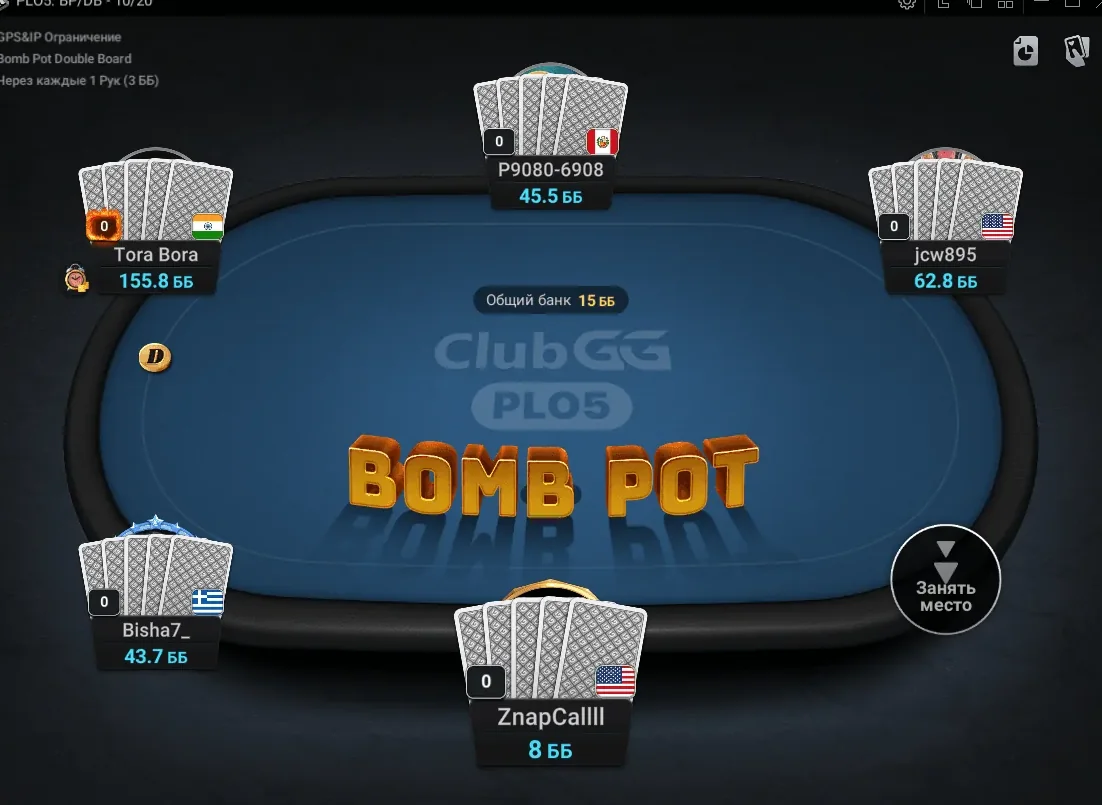
The simplest anti-collusion tool is to stop partners from sitting together in the first place. ClubGG lets clubs switch on GPS / IP restriction on a table: players from the same network or physically close to each other can’t sit there together. The table shows a mark in the top-left corner when it’s active.
A ClubGG table with the “GPS/IP restriction” mark in the top-left corner
If an app asks for location access to seat you at such a table, that’s why. Players from the same household or office will be kept apart — sit at another table rather than trying to get around it. Trying to hide your location or network looks exactly like what the restriction is there to catch, and clubs treat it as such.
Нужен скриншотClubGG: the message shown when you try to sit at a GPS/IP-restricted table without location access
What the apps do against cheating
Apps differ a lot in how much they publish about their security. Here’s what we can point to for each.
Reviews accounts for bots and shared IP, GPS and device data; tables can use GPS / IP restriction; RTA and bots are banned; the built-in Smart HUD and PokerCraft replace third-party tools
Depends on club moderation — choose clubs with clear rules
In every app, the club is the first line of defence: it decides who gets in, which tables are restricted, and whether a report leads to a ban. ClubGG states that it doesn’t mediate disputes between players, but does review accounts for bots and linked devices.
What a well-run club does
Clear rulesNames what’s banned — software, multi-accounting, sharing devices — before you join.
Restricted tablesUses GPS / IP restriction where the app offers it, especially at higher stakes.
MonitoringManagers watch member activity — in ClubGG they can see who plays where with Trace Player and check agent statistics.
Real consequencesBans cheaters and explains what happened to the affected players.
How clubs handle the money side when cheating is found depends on the club. Ask your agent what happens to a banned cheater’s balance — whether affected players are compensated or not tells you a lot about the club.
What you can do: report it properly
1
Write down hand numbers and the nicknames involved as soon as something looks wrong. Without hand IDs, a report is just a feeling.
2
Review the hands in the hand history. In ClubGG every hand is saved in PokerCraft and can be replayed.Нужен скриншотClubGG PokerCraft: a hand replay with the hand number and all players’ actions
3
Report to your agent and the club manager with the hand numbers and what you noticed. Keep it factual.
4
Report to the app’s support as well — bots and linked accounts are something the app itself reviews.
5
Leave the table while it’s being checked. Don’t try to “outplay” suspected colluders, and don’t accuse anyone in the table chat.
Don’t
Retaliate by teaming up with a friend — you become the colluder.
Post names publicly before the club has looked at it.
Keep playing a table you believe is compromised “to win it back”.
Don’t become the suspect yourself
Anti-cheat systems catch honest players too. Most of these cases are avoidable.
One account per person, on your own device.
Don’t sit at the same table as family, roommates or friends on the same network.
Don’t lend your account or log into a friend’s on your phone.
Use only allowed tools — in ClubGG that’s Smart HUD and PokerCraft; no third-party HUDs or helpers during play.
Tell the club in advance if someone in your household plays there too.
If your balance does get frozen over a false match, here’s how to handle it: the club froze my balance.
Choosing moderated clubs
The same app can host a strictly moderated club and a free-for-all next to each other. Look for clubs that have been around for a while, belong to a known union and have player reviews mentioning how complaints were handled.
Before you join
Ask the agent which software is allowed and how the club checks for collusion.
Ask whether higher-stakes tables use GPS / IP restriction.
Ask what happens to a cheater’s balance and to the players who lost to them.
Read reviews about disputes, not just about rakeback.
ClubGG reviews accounts for bots and bans them, and bots are against the rules. The risk is higher in weakly moderated clubs, so choose clubs with a reputation.
02What is GPS / IP restriction?
A table setting that stops players from the same network or the same location from sitting together. In ClubGG it’s shown by a mark in the top-left corner of the table.
03Is using a HUD cheating?
It depends on the app and club. In ClubGG the built-in Smart HUD is allowed, while third-party HUDs and real-time assistants are banned. In PPPoker most serious clubs ban third-party software.
04How do I report collusion?
Note the hand numbers and nicknames, then report to your agent and the club manager, and to the app’s support. Hand IDs make the report checkable.
05Can my family play in the same club?
Usually yes, but tell the club and never sit at the same table. Shared Wi-Fi and devices can make two players look like one.
06Will I get my money back if I lost to cheaters?
It depends on the club. Some clubs return funds taken by banned accounts, others don’t — ask before you join.





 MOJO 2 4.5 · rakeback 50% · Massive Poker Union2
 MOJO 1No reviews yet · rakeback 50% · AllinUnion3
 Mr Pink PantherNo reviews yet · rakeback 40%4
 ZerakeNo reviews yet · rakeback Zero Rake5
 POKER VIBE UANo reviews yet · rakeback 40%All clubs in the catalog