GTO Poker Explained: What It Is, Solvers, Trainers and How to Actually Use It (2026)
“GTO” gets thrown around in every poker chat, usually as a synonym for “correct”. It is narrower than that: GTO is a strategy that cannot be exploited, computed by solvers for a simplified game. You do not need to memorise it — you need to understand what it says, learn a few principles, and know when to leave it behind. This article explains GTO without the maths degree, lists the solvers and trainers people actually use, and shows how it applies at the soft tables of club apps.
Updated: 23 October 2026- GTO (game theory optimal) is an unexploitable strategy: whatever your opponent does, they cannot gain an edge over you in the long run. It is a defence, not a maximum-profit plan.
- GTO solutions come from solvers — programs that compute equilibrium strategies for a given spot. Trainers let you drill those solutions until the patterns stick.
- Against weak players (most club-app tables) the money is in exploiting: deviating from GTO on purpose. GTO is the baseline you deviate from, and the fallback when you don’t know the opponent.
- You can learn the core of GTO without software: preflop ranges, bet sizings, minimum defence frequency and bluff-to-value ratios. Short-stack spots are fully solved — see our push/fold charts.
- Using a solver or trainer during a hand is real-time assistance and gets accounts banned in rooms and club apps alike. Study away from the table.
What GTO is — and what it is not
In game theory an equilibrium is a pair of strategies where neither player can improve by changing only their own play. Applied to poker: if you play the equilibrium strategy, no opponent can beat you in the long run no matter what they try. If they play badly, you still profit — not as much as you could by adjusting, but you never become the one being exploited. That is GTO.
Two ideas make it work. Balance: every action you take (bet, check, raise) contains both strong hands and bluffs in proportions that make your opponent’s decision hard. Indifference: your proportions are chosen so that the opponent’s reasonable options (call or fold, for example) earn the same — so there is nothing to exploit.
Where GTO comes from: solvers
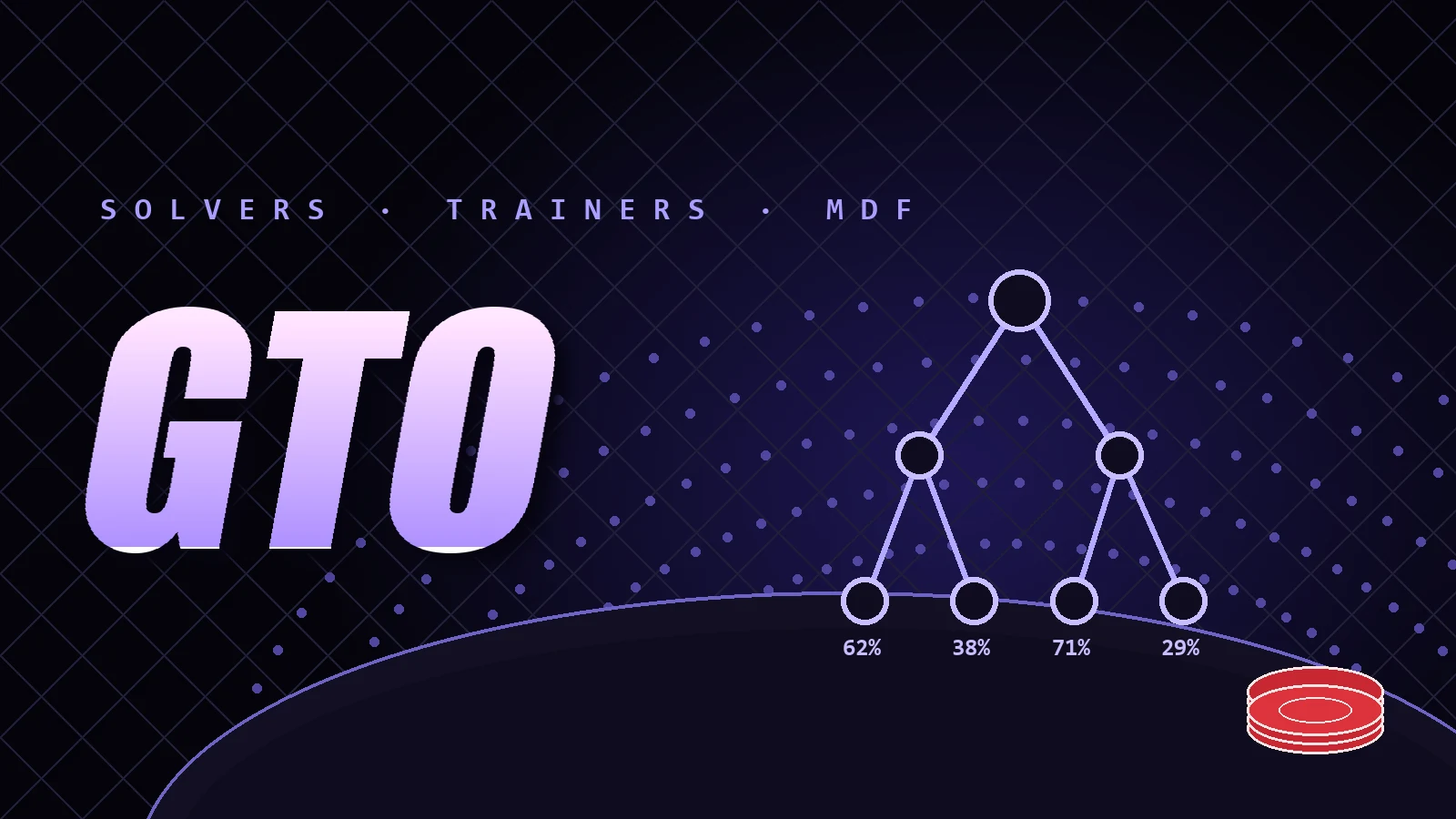
No human can calculate an equilibrium for a poker hand. Solvers do: you describe a spot — the board, each player’s range, the stack and the bet sizes allowed — and the program iterates until it finds strategies neither side can improve. The output is a frequency for every hand in every situation: “bet 75% pot with AK 62% of the time, check 38%”.
Important caveat: a solver solves the game you gave it. Real poker has any bet size, several opponents and players who don’t hold the ranges you assumed. Solver output is a very good approximation of equilibrium for a simplified model, not a divine truth. That is why ranges and sizing trees matter as much as the solve itself.
| Solver | Type | What it is for |
|---|---|---|
| PioSolver | Desktop, paid | The industry standard for postflop hold’em: full control over trees, scripts, aggregated reports |
| GTO+ | Desktop, paid | Cheaper postflop solver with a friendlier interface, popular with players who don’t need scripting |
| Simple Postflop / Simple Preflop | Desktop and cloud, paid | Postflop and preflop solving, including multiway spots |
| TexasSolver | Desktop, free, open source | A capable postflop solver for hold’em and short deck — the usual starting point for a zero budget |
| GTO Wizard | Web, free tier + paid | Pre-solved libraries for cash, MTT and spins plus a built-in solver and trainer; no setup, works in the browser |
If you have never opened a solver, start with a library (GTO Wizard’s free solutions or the preflop charts in any trainer) rather than solving spots yourself. The value is in seeing the patterns — which boards favour which range, how sizes change with stack depth — not in running your own simulations.
GTO trainers: how people actually learn it
A solver gives you a table of frequencies; a trainer turns it into practice. You get a hand in a solved spot, choose an action, and the trainer tells you how far from the solution you were and why. Thousands of these repetitions build intuition that no chart alone provides.
| Trainer | Format | Strengths |
|---|---|---|
| GTO Wizard | Web | Drills on its own solved library for cash, MTT, spins and heads-up; detailed reports on your mistakes by street and hand class |
| DTO Poker Trainer | Mobile and web | Built around MTT ranges, quick sessions on the phone, preflop and postflop drills |
| Octopi Poker | Web | Solver-backed trainer and study tools with an emphasis on explanations, not just frequencies |
| PokerSnowie | Desktop and web | An AI that plays near equilibrium; you play hands against it and it grades every decision |
| GTO+ (trainer mode) | Desktop | Practice directly on the trees you solved yourself |
- How to study with a trainer so it sticks
- Drill one spot family at a time — for example “BTN vs BB single-raised pots on low boards” — until your error rate drops, then move on.
- Read the why behind every miss: which hand class the solver bets, which it checks, and what makes the difference (blockers, equity, board texture).
- Mark the spots you got wrong and come back to them a week later. Spaced repetition works for poker as well as for languages.
- Compare the trainer’s ranges with how real opponents play at your stakes — that gap is where your exploits live.
GTO principles you can learn without software
A handful of rules of thumb capture most of what a solver would tell you in common spots. They are approximations, but they are the approximations strong players run on.
Preflop ranges
Preflop is the most “solved” street: open-raising, 3-betting and calling ranges by position are available in every trainer and in free charts. Learn them by position and stack depth. For short stacks the problem is fully solved — our Nash push/fold charts give the exact shove and call ranges for 1–25 big blinds, which is GTO for that spot.
Minimum defence frequency (MDF)
When facing a bet, GTO says you must continue often enough that a bluff with zero equity does not profit. MDF = pot ÷ (pot + bet). Against a half-pot bet you defend 67% of your range; against a pot-sized bet, 50%; against a 2× overbet, 33%. Fold more than that and you can be bluffed at will.
Bluff-to-value ratio (alpha)
When you bet, the share of bluffs that makes the opponent indifferent is bet ÷ (bet + pot after the call). A pot-sized river bet should be about one-third bluffs; a half-pot bet about one-quarter. On earlier streets you can bluff more, because bluffs still have equity to improve.
| Bet size | MDF (you defend) | Bluffs in your river bet |
|---|---|---|
| ⅓ pot | 75% | 20% |
| ½ pot | 67% | 25% |
| ⅔ pot | 60% | 29% |
| Pot | 50% | 33% |
| 2× pot | 33% | 40% |
Sizing and range advantage
Solvers bet small and often on boards that favour the preflop raiser (high cards, dry textures) and large or not at all on boards that hit the caller (low, connected). The player whose range holds more of the strongest hands — the nut advantage — gets to use big sizes and overbets. Learn to ask “whose range is this board for?” before choosing a size.
Blockers
GTO bluffs are chosen by what they block: a hand holding the ace of the flush suit on a three-flush river is a better bluff than a random hand, because it removes the opponent’s nut flushes. The same logic picks which hands call: ones that block bluffs are bad calls, ones that block value are good calls.
GTO at club-app tables
Club apps — ClubGG, PPPoker, PokerBros and the rest — are known for soft, recreational fields. Here GTO is the wrong goal and the right foundation. The wrong goal because a balanced strategy leaves money on the table against players who never fold a pair or never bluff a river. The right foundation because you need a baseline to deviate from and a safe mode against the one regular at the table.
A simple study plan
- Learn preflop ranges first — they are cheap to memorise and appear in every hand.
- Add the short-stack game: push/fold is both GTO and the most common tournament spot. Our charts and ICM calculator cover it.
- Understand MDF and alpha well enough to estimate them at the table from the bet size.
- Drill one spot family in a trainer until the error rate falls, then the next.
- Keep notes on regular opponents in your club and write down how you deviate against each one.

01What does GTO stand for in poker?
Game theory optimal — a strategy at equilibrium, where no opponent can gain an edge over you in the long run whatever they do.
02Is GTO the best way to play?
It is the safest, not the most profitable. Against weak opponents an exploitative strategy earns more; GTO is the baseline you adjust from and the fallback against unknown or strong players.
03Do I need a solver to learn GTO?
No. Preflop ranges, push/fold charts, MDF and bluff ratios can be learned from free charts and articles. Solvers and trainers come later, when you want to refine postflop play.
04What is the best GTO trainer?
GTO Wizard is the most widely used web trainer with a free tier; DTO is popular for MTT drills on the phone; PokerSnowie lets you play against a near-equilibrium AI. Any of them works if you drill consistently.
05Can I use a GTO trainer while playing in PPPoker or ClubGG?
No. Real-time assistance of any kind is banned in club apps and poker rooms, detected by the clients, and punished with account bans and frozen balances. Use trainers only for study away from the table.
06Is push/fold GTO?
Yes. Heads-up push/fold ranges for short stacks are solved exactly (Nash equilibrium) — it is one of the few spots where the full GTO solution fits on one chart.
Read next
 ROI and ITM in Poker: What They Mean, What Numbers Are Good and How to Calculate Them (2026)Read
 How to Play Poker Online with Friends: Your Own ClubGG Club and a No-Rake Table (2026)Read
 Triton Poker: the Super High Roller Series Explained (2026)Read
 Poker Calculator: Free Odds, Equity, ICM and Bankroll Tools Explained (2026)Read
 Famous Poker Players: Legends, the “King of Poker” and Today’s StarsRead
 History of Poker: Where the Word Comes From, How the Game Spread and the Moneymaker EffectRead