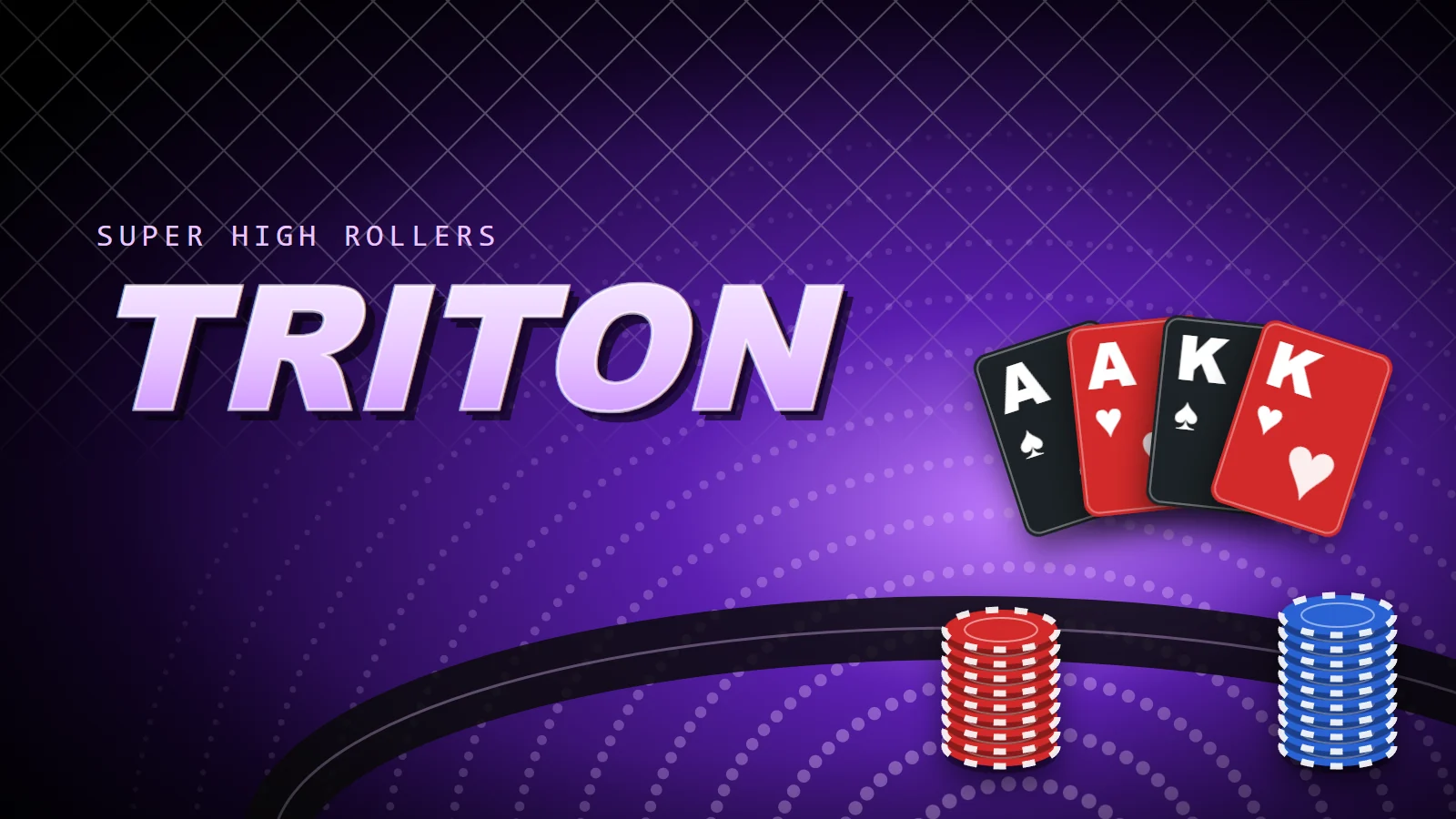
Triton Poker: the Super High Roller Series Explained (2026)
Triton is where the biggest tournament buy-ins in poker are played. The series started in Asia, now travels to different countries, and brings together elite professionals and wealthy businessmen who play for fun. For most of us it is something to watch, not to play — but the broadcasts with hole cards are one of the best free poker lessons there is. Here is what Triton is, how it works and what you can take from it.
Updated: 20 October 2026- Triton Poker Super High Roller Series is a series of high-roller tournaments and cash games, started in Asia by businessmen and keen players Paul Phua and Richard Yong.
- Tournament buy-ins are usually huge — often from $25,000 to $200,000 and more. Fields are small, mostly elite pros and wealthy recreational players.
- The main games are No-Limit Hold’em and Short Deck, which Triton helped popularise in the late 2010s.
- Final tables and cash games are published on Triton’s official YouTube channel with hole cards and commentary.
- Compared with the WSOP and EPT, Triton is not a mass festival: fewer players, much bigger buy-ins, almost only the top end of the game.
What is Triton Poker
Triton Poker — full name Triton Poker Super High Roller Series — is a travelling series of high-stakes poker events. A typical Triton stop is a run of tournaments over one to two weeks, plus private cash games played alongside. Almost every event is a high roller or super high roller: tournaments where the buy-in alone is more than most players’ yearly poker budget.
What makes Triton special is the mix at the table. Alongside the strongest tournament professionals sit wealthy recreational players — businessmen who love the game and can afford the stakes. That mix is what keeps the buy-ins so high: pros come because the prize pools are large, recreational players come for the competition and the atmosphere.
How Triton started: from Asia to the world
Triton grew out of the high-stakes games of Paul Phua and Richard Yong, Malaysian businessmen and long-time players of big games. In the mid-2010s their circle turned into an organised tournament series. The early stops were in Asia; later the series began to travel and has been held in different countries of Asia and Europe — for example, in Montenegro, Cyprus and on Jeju Island in South Korea.
Buy-ins and the format of the events
Triton tournaments are expensive by any standard. Buy-ins are often in the range of $25,000 to $200,000, and the biggest events go higher still. Fields are small — often tens of entries, in the biggest events sometimes over a hundred — and many events allow re-entry, so the same player can buy in more than once.
| Feature | How it usually works at Triton |
|---|---|
| Buy-ins | High roller and super high roller: often $25k–$200k and more |
| Field size | Small — usually tens of entries, sometimes over a hundred |
| Re-entry | Allowed in many events |
| Games | Mostly No-Limit Hold’em and Short Deck, sometimes Omaha |
| Who plays | Top tournament pros and wealthy recreational players |
| Cash games | Private, very high stakes, often broadcast |
Because the field is small, the prize pool is paid to only a few places, and final tables are usually short-handed. That makes ICM — the money value of chips near the payouts — even more important than in a normal tournament. You can see how it works in our ICM calculator.
Short Deck and Triton
Triton is the place that turned Short Deck (6+ Hold’em) from an exotic Asian cash game into a format every high-stakes player knows. In the late 2010s Short Deck cash games and tournaments became a regular part of the series, the broadcasts showed them to a global audience, and other series and apps followed.
- The deck has 36 cards: 2s to 5s are removed.
- A flush beats a full house, because flushes are harder to make with nine cards per suit.
- The lowest straight is A-6-7-8-9.
- Under the rules used at high stakes, three of a kind beats a straight; Short Deck is often played with antes rather than blinds.
If you want to try Short Deck yourself, start with the rules and the changed odds in our Short Deck guide. Several club apps run Short Deck tables at stakes far below Triton.
Notable Triton events
Most Triton stops follow a similar pattern: a series of Hold’em and Short Deck tournaments with rising buy-ins, a main event or a flagship super high roller, and cash games around them. Some events stand out:
Triton cash games
The cash games are where Triton began, and they are still part of its identity. These are private, invitation-style games: the line-up is agreed in advance, the stakes are among the highest in poker, and the table often includes the founders and their business friends together with famous professionals. Over the years well-known names such as Phil Ivey and Tom Dwan have appeared in Triton cash games.
For viewers these episodes are especially interesting: you see full hands with hole cards, deep stacks and players who are not afraid to make big bluffs or hero calls. Remember that such play works in that game with those opponents — copying it at a low-stakes club table is a fast way to lose money.
Well-known Triton regulars
The Triton field changes from stop to stop, but some names are seen there regularly. Among the best-known players who have played the series:
| Player | Country | Who they are |
|---|---|---|
| Paul Phua | Malaysia | Co-founder of Triton, plays both tournaments and cash games |
| Richard Yong | Malaysia | Co-founder of Triton, a regular in the big games |
| Jason Koon | USA | One of the most successful high-roller tournament players |
| Mikita Badziakouski | Belarus | Regular of the highest-stakes tournaments |
| Stephen Chidwick | United Kingdom | Top high-roller tournament pro |
| Dan Smith | USA | Long-time high-roller regular |
| Justin Bonomo | USA | High-roller tournament pro |
| Bryn Kenney | USA | High-roller tournament pro |
| Wai Kin Yong | Malaysia | Regular of Triton tournaments |
| Artur Martirosian | Russia | Russian-speaking high-roller regular |
More about the biggest names in the game — in our article on famous poker players.
Where to watch Triton Poker
Triton publishes its broadcasts on its official YouTube channel: final tables of tournaments, cash game sessions and highlights. The production shows hole cards, commentary and on-screen stats, so you can follow every decision. Broadcasts are usually shown with a delay — this protects the game, because players cannot see their opponents’ cards in real time.
- 1Find the official Triton Poker channel on YouTube (check that it is the verified channel, not a reupload).
- 2Pick a playlist: tournament final tables, cash games or Short Deck.
- 3Watch with pauses: before each decision, stop the video and decide what you would do.
- 4Check the spot afterwards — for example, the equity of an all-in in our equity calculator.
What regular players can learn from Triton
You will never play these stakes, and you don’t need to. The decisions at a Triton table follow the same logic as at a micro-stakes tournament — just with better players and more money. The broadcasts are a free library of high-level hands.
Watching big swings at Triton is also a lesson in variance: even the best players in the world lose most tournaments they enter. The principles of long-run winning are in how to win at poker.
Triton vs WSOP vs EPT
Triton is often mentioned next to the two most famous live series, but it is a different kind of event.
| Triton | WSOP | EPT | |
|---|---|---|---|
| What it is | Super high roller series | World Series of Poker, Las Vegas, since 1970 | European Poker Tour by PokerStars, since 2004 |
| Buy-ins | Usually high roller only: often $25k–$200k+ | From a few hundred dollars to high rollers; Main Event $10,000 | From side events to high rollers; Main Events usually several thousand euros |
| Field size | Small, usually tens of entries | Huge, the Main Event draws thousands | Large, main events often hundreds to over a thousand |
| Games | NLH and Short Deck, sometimes Omaha | Almost every game: Hold’em, Omaha, Stud, mixed games | Mostly NLH, also Omaha |
| Who plays | Elite pros and wealthy recreational players | Everyone, from amateurs to pros | Amateurs, qualifiers and pros |
In short: the WSOP and EPT are festivals for everyone, with events for most budgets and online satellites into them; Triton is the very top of the pyramid. If you want to understand how live and online tournaments are structured, start with our poker tournaments guide.
Can you play Triton — and what to do instead
Triton tournaments are, as a rule, open to anyone who can pay the buy-in, while the cash games are private. But a bankroll for regular play at those stakes is measured in millions of dollars, so for almost everyone Triton is something to watch.
- How to get closer to high-stakes poker
- Play high-roller-style tournaments at your own stakes: online series and club tournaments with deep stacks.
- Try Short Deck at low stakes in club apps before playing it for real money anywhere bigger.
- Keep a bankroll that matches your buy-ins — see bankroll for club poker and the bankroll calculator.
- Watch Triton broadcasts as study material, not as a blueprint to copy.
ClubGG clubs from our catalog
Ranked by player reviews; each club page lists its games, rake and rakeback.


FAQ
01What is Triton Poker?
The Triton Poker Super High Roller Series — a travelling series of high-roller tournaments and private cash games that started in Asia. Buy-ins are among the highest in poker.
02Who founded Triton Poker?
Triton grew out of the high-stakes games of Malaysian businessmen Paul Phua and Richard Yong, who still play in the series.
03How much is the buy-in at Triton?
Buy-ins vary by event, but they are usually very high — often from $25,000 to $200,000 and more. Check the official schedule for each stop.
04What games are played at Triton?
Mostly No-Limit Hold’em and Short Deck (6+ Hold’em). Some stops also include Omaha events.
05Why is Triton connected with Short Deck?
Triton made Short Deck a regular part of its cash games and tournaments in the late 2010s, and its broadcasts introduced the format to players around the world.
06Where can I watch Triton Poker?
On Triton’s official YouTube channel: tournament final tables, cash games and highlights with hole cards and commentary, usually shown with a delay.
07How is Triton different from the WSOP?
The WSOP is a huge festival in Las Vegas with events from a few hundred dollars and thousands of players. Triton is a small, very expensive series for elite pros and wealthy recreational players.
Read next
 How to Play Poker Online with Friends: Your Own ClubGG Club and a No-Rake Table (2026)Read
 Poker Calculator: Free Odds, Equity, ICM and Bankroll Tools Explained (2026)Read
 Famous Poker Players: Legends, the “King of Poker” and Today’s StarsRead
 History of Poker: Where the Word Comes From, How the Game Spread and the Moneymaker EffectRead

 Poker on Android: The Best Apps and How to Play on Your PhoneRead
 World Poker Club and Poker on VK: Free Social Poker ExplainedRead