




Poker Variance Explained: Why Bad Beats Happen and Why Apps Aren’t Rigged (2026)
You got all-in with aces against kings and lost. Then it happened again the next day. It’s tempting to blame the app — but the maths says this is exactly what poker looks like in the short run. Here’s how variance works, how to measure your luck honestly, and how to tell normal swings from real problems.
Updated: 16 October 2026- Variance is the gap between what you should win on average (your expected value) and what you actually win in a given session.
- Even a big favourite loses often: aces against kings preflop lose about 1 time in 5.5.
- All-in EV shows what you’d have won if every all-in paid out at its equity — compare it to your real results.
- It takes tens of thousands of hands before results say much about skill; downswings are normal even for winners.
- PLO, bomb pots and tournaments swing harder than hold’em cash. Certified RNGs and no confirmed rigging cases — the real risks in club apps are collusion and dishonest agents.
Variance vs expected value
Every decision in poker has an expected value (EV) — what it wins or loses on average if you could repeat it thousands of times. A good decision has positive EV. But you don’t get the average: you get one result, and that result is scattered around the average. That scatter is variance.
Example: a good call that usually loses
On the river there’s $100 in the pot and your opponent bets $50. You call $50 to win $150, so you need to be right just 25% of the time. If you’re ahead 40% of the time, the call earns on average 0.4 × $150 − 0.6 × $50 = +$30. You’ll still lose this spot six times out of ten — and every one of those losses was a correct decision.
All-in equity: the numbers behind bad beats
A “bad beat” is just the smaller number in an equity split showing up. Here are some common all-in situations in hold’em, with approximate equities:
| Situation | Favourite | Underdog | Underdog wins about |
|---|---|---|---|
| AA vs KK, preflop | ~82% | ~18% | 1 time in 5.5 |
| Pair vs two overcards (QQ vs AK), preflop | ~55% | ~45% | Almost a coin flip |
| Made hand vs flush draw (9 outs), flop | ~65% | ~35% | 1 time in 3 |
| Made hand vs open-ended straight draw (8 outs), flop | ~69% | ~31% | 1 time in 3.2 |
| Made hand vs gutshot (4 outs), flop | ~83% | ~17% | 1 time in 6 |
Quick way to estimate it at the table: count your outs (cards that win for you) and multiply by 4 on the flop with two cards to come, or by 2 on the turn with one card to come. Nine outs on the flop ≈ 36%, on the turn ≈ 18%. It’s approximate, but close enough for real decisions.
In Omaha the numbers sit much closer together. Preflop all-ins between two decent PLO hands are often nearer 60/40 or even 55/45 than 80/20 — which is why PLO swings so much more than hold’em.
All-in EV: separating luck from decisions
All-in EV is a second result line: for every hand where the money went in before the river, it counts your equity share of the pot instead of the actual outcome. Win AA vs KK for $100 each and the all-in EV line adds about +$64, not +$100. Lose it — the line still adds about +$64, while your real result shows −$100.
If your real winnings sit well below the all-in EV line, you’ve been unlucky in all-ins. If they sit above it, you’ve run hot. Over a big enough sample the two lines move closer together.
It’s also the simplest fairness check for ClubGG: compare real results with all-in EV in PokerCraft over several thousand hands. If the lines are close, the deal is fair and the rest is variance.
Sample size: when results start to mean something
Results converge to EV slowly. To see how slowly, take an example: a player who truly wins 5 big blinds per 100 hands, with a standard deviation of 90 BB per 100 hands — a typical order of magnitude for 6-max NLHE (PLO is usually higher). Using the normal approximation:
| Hands played | Expected result | ± 1 standard deviation | Chance of still being down |
|---|---|---|---|
| 1,000 | +50 BB | ± 285 BB | ~43% |
| 10,000 | +500 BB | ± 900 BB | ~29% |
| 50,000 | +2,500 BB | ± 2,010 BB | ~11% |
| 100,000 | +5,000 BB | ± 2,850 BB | ~4% |
In practice: a thousand hands — a few evenings on a phone — tells you almost nothing about whether you’re a winning player. Ten thousand tells you a little. That cuts both ways: a hot first week doesn’t prove you’re crushing either.
Downswings are normal — even for winners
In the same example, one standard deviation over 10,000 hands is 900 BB — nine full buy-ins. Running nine buy-ins below expectation over that stretch happens roughly one time in six. For a player who expects to be up five buy-ins, that’s a losing month that has nothing to do with skill or with the app.
Formats that swing harder
Some games are built for action, and action means variance. Club apps are full of them — that’s part of why they’re fun.
| Format | Variance | Why |
|---|---|---|
| NLHE cash, full ring | Lower | Tighter ranges, fewer marginal all-ins |
| NLHE cash, 6-max | Medium | More hands per orbit, wider ranges, more aggression |
| PLO (4 cards) | High | Equities run close; big pots are common |
| PLO5 / PLO6 | Higher | Even closer equities, more draws, more multiway pots |
| Bomb pots, double board | Very high | Everyone antes, the flop comes straight away, pots are big from the first street |
| Short Deck, all-in or fold | High | Hands run closer together or go all-in by design — see AoF poker |
| Tournaments, especially bounty (KO) | Very high | Most of the value is in rare deep runs |
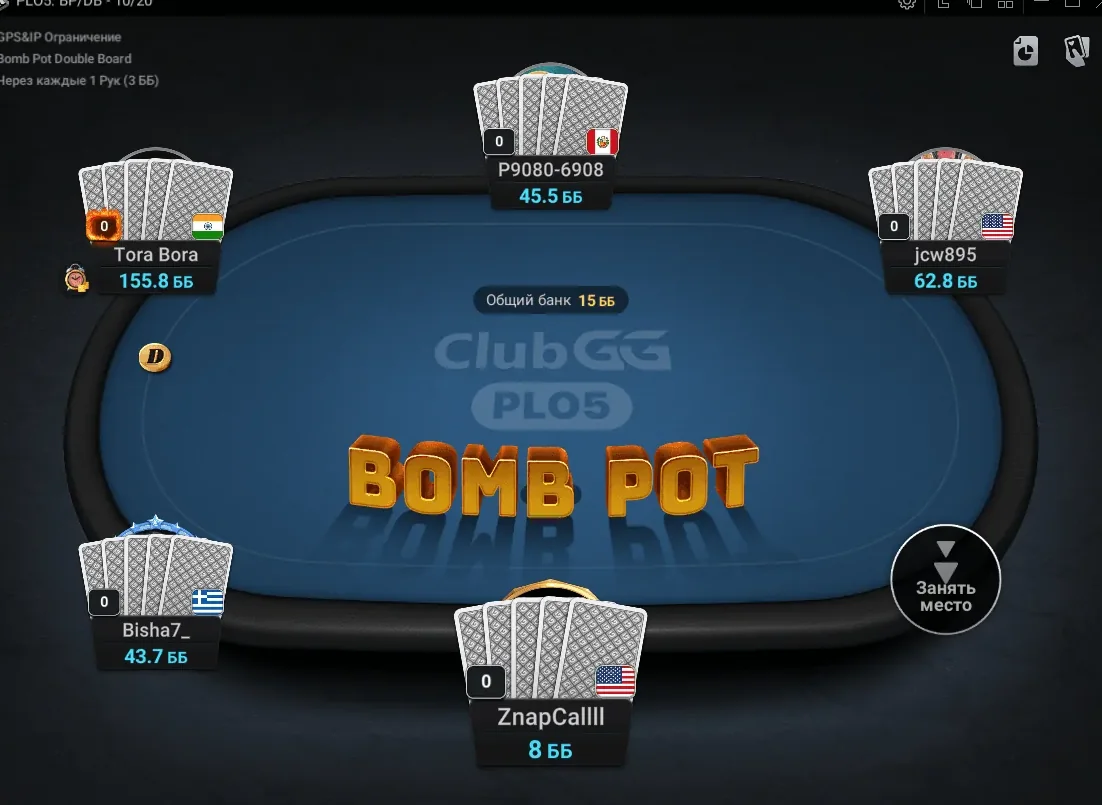
If you love these formats, size your bankroll for them and expect bigger swings. More on the games themselves: bomb pots and PLO5 and PLO6. If you play bounty tournaments, our Ocean KO calculator helps you work through bounty spots.
Run it twice: less variance, same EV
Some tables let you run the board more than once after an all-in. The pot is split between the runs, so a single unlucky card costs you less. It doesn’t change your expected value — it only narrows the swing. In ClubGG the table’s options are listed in its top-left corner.
Why it feels rigged
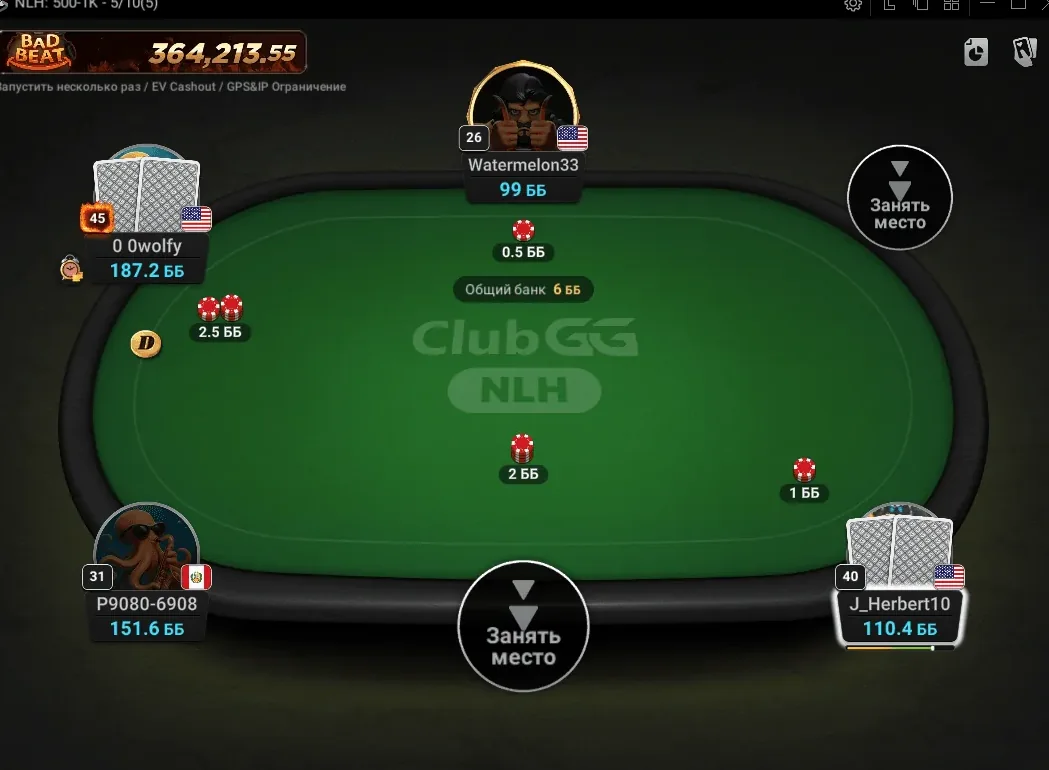
“Rigged for action” is one of the most common complaints about poker apps. The feeling is real; the cause is usually the format and the way memory works.
A full breakdown of the “rigged” question: are poker apps rigged?
Why the apps aren’t rigged — and what the real risks are
Several major club apps have their random number generators tested by independent labs, and there are no confirmed cases of the deal being rigged in them. There’s also no business reason to rig it: the club takes rake from every pot no matter who wins it.
| App | RNG |
|---|---|
| ClubGG | Certified by BMM Testlabs |
| PokerBros | Certified RNG (BMM Testlabs) |
| Pokerrrr 2 | Certified by Gaming Labs |
| PPPoker, Suprema, X-Poker | No confirmed RNG-rigging cases |
The real threats in club poker don’t come from the shuffle — they come from people:
How to live with variance
- Play with a proper bankroll for your format, so a downswing doesn’t end your poker.
- Check your all-in EV line before deciding you’re “cursed” — and look at thousands of hands, not one night.
- Review big hands by the decision: were you a favourite when the money went in?
- Set a stop-loss and a time limit before each session.
- Move down in stakes during a long downswing — it lowers the pressure without stopping you playing.
- Pick formats that match your nerves: if bomb pots ruin your mood, play regular NLHE.
- What doesn’t help
- Moving up to “win it back faster”.
- Changing a solid strategy after a few bad sessions.
- Calling “because they always have it” or “because I’m due”.
- Switching clubs or apps every time you lose, hoping the cards will be kinder.
FAQ
01What is variance in poker?
The difference between your expected result and your actual result. In the short run luck dominates; over many thousands of hands results move toward expected value.
02What is all-in EV?
Your result if every all-in before the river had paid out at your equity share of the pot. Comparing it to your real winnings shows how lucky you’ve been in all-ins.
03How many hands do I need to know if I’m a winning player?
Tens of thousands at least. In our example, a player winning 5 BB per 100 hands still has roughly a 29% chance of being down after 10,000 hands.
04Why do I lose with aces so often?
Aces win about 82% against kings preflop, so they lose roughly 1 time in 5.5. Against several opponents they win less often. Fast apps simply show you more of those hands per hour.
05Are poker apps rigged?
ClubGG’s RNG is certified by BMM Testlabs, PokerBros has a certified RNG and Pokerrrr 2 is Gaming Labs certified, with no confirmed rigging cases. The real risks are collusion, bots and dishonest agents.
06Does running it twice change my winnings?
No. It splits the pot between two boards and reduces swings, but your expected value stays the same.
Read next
All-in or Fold (AoF) Poker: Rules and Push/Fold Strategy (2026)Read  Are Poker Apps Rigged? ClubGG, PPPoker, PokerBros and OthersRead Best Poker Apps for Low Stakes and Beginners (2026)Read Best Club Poker Apps in 2026: Ranked by Player ReviewsRead Bomb Pot Poker: Rules, Strategy and Where to Play (2026)Read ClubGG vs PPPoker vs PokerBros: Which Club Poker App to Choose (2026)Read