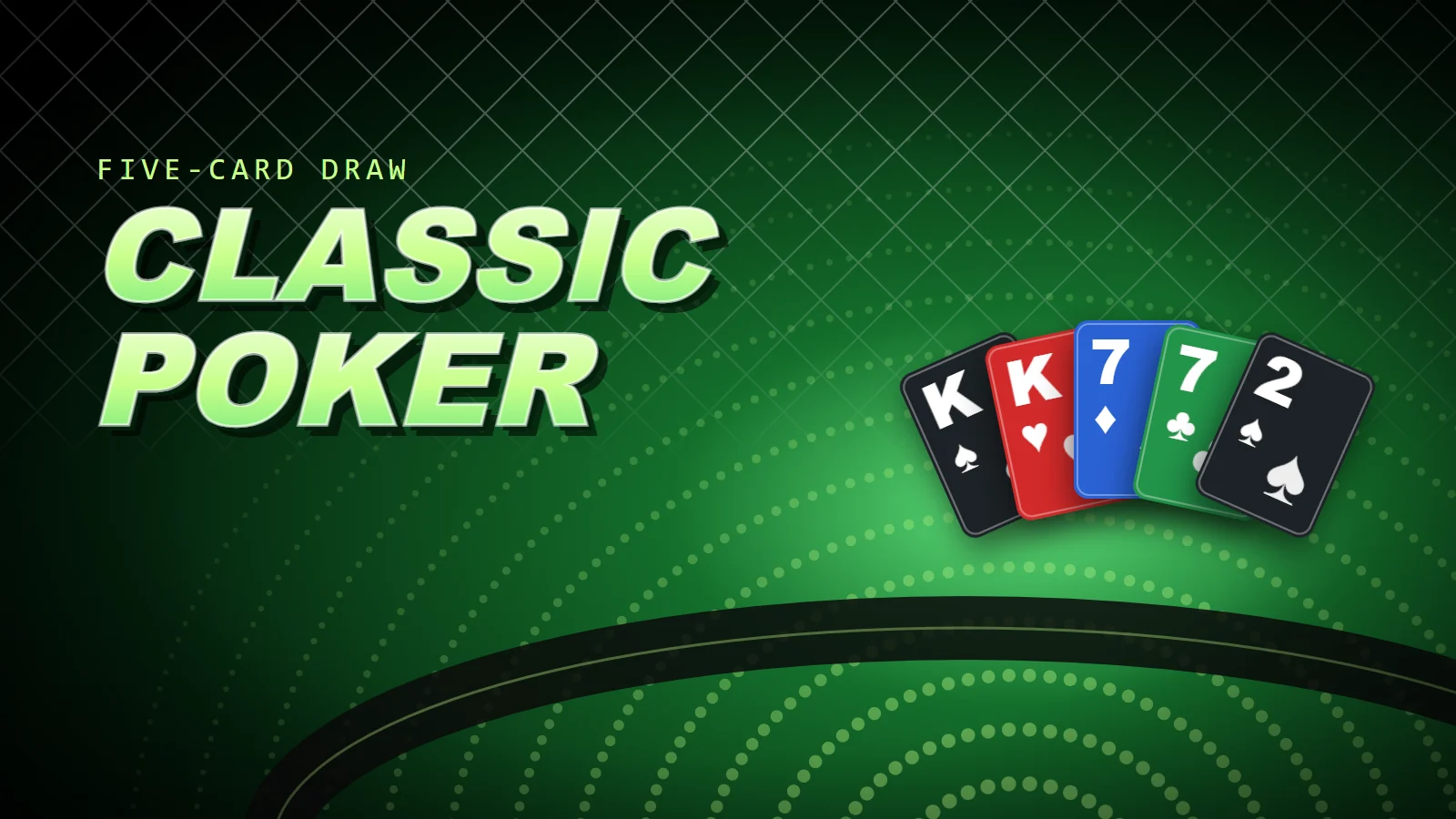



Classic Poker (Five-Card Draw): Rules and How to Play (2026)
Five cards each, one chance to swap the ones you don’t like, two rounds of betting — that’s classic poker, the game from old films and kitchen-table nights. It takes a minute to explain and still rewards smart play: what to keep, how many cards to draw and what your opponents’ draws give away. Here are the full rules step by step, the hand rankings, the odds and the basic strategy.
Updated: 20 October 2026- Classic poker usually means five-card draw: everyone gets five face-down cards, there’s a betting round, one draw, a second betting round and a showdown.
- On the draw you discard and replace cards — typically up to three, or four if you keep an ace; some home games allow any number. Agree before you start.
- Hand rankings are the same as in Texas Hold’em: from royal flush down to high card.
- Basic strategy: keep made hands, draw three to a pair, one to two pair or a four-flush, and fold most hands with nothing.
What is classic poker
Five-card draw is one of the oldest forms of poker and the one most people call “classic” or “regular” poker. There are no community cards: each player has a private five-card hand, and the only way to improve it is a single exchange of cards called the draw. The best five-card hand at showdown wins the pot — or the last player left if everyone else folds.
Draw poker was the main poker game for most of the 19th and early 20th century, before stud and then Texas Hold’em took over. Today it lives on mainly in home games and as a base for lowball draw games. For an overview of all poker families, see types of poker.
Classic poker rules step by step
- 1Seat and dealer. Choose the first dealer (for example, by the highest card). The deal passes one seat clockwise after each hand.
- 2Forced bets. Every player posts an ante, or the two players to the dealer’s left post a small and a big blind — whichever your game uses.
- 3The deal. After a shuffle and a cut, the dealer deals five cards face down to each player, one at a time, clockwise, starting from the player on the left.
- 4First betting round. With antes, the player to the dealer’s left acts first; with blinds, the player to the left of the big blind. Each player can check (if no bet yet), bet, call, raise or fold.
- 5The draw. Starting left of the dealer, each remaining player discards the cards they don’t want face down and says how many they need; the dealer gives the same number of new cards. Keeping all five is called standing pat.
- 6Second betting round. Usually starts with the first active player to the dealer’s left (in some rules — with the player who opened the betting). Bets after the draw are often double those before it in limit games.
- 7Showdown. If two or more players remain, hands are shown — usually the last player to bet or raise shows first. The best five-card hand takes the pot; identical hands split it.
Antes, blinds and openers
There are a few common ways to start the pot. All of them are fine; the point is that there is always something to win, so nobody can just wait for aces.
| Option | How it works | Where it’s common |
|---|---|---|
| Antes | Every player puts in the same small amount before the deal | Traditional home games |
| Blinds | Small and big blind left of the dealer, as in Hold’em | Casinos and online versions |
| Jacks or better (openers) | You can open the betting only with a pair of jacks or better; if nobody opens, the hand is redealt and the antes stay in the pot | Old-school home games |
| Dealer’s ante | Only the dealer antes for the whole table | Casual games, simpler chip handling |
With jacks or better, the player who opened must be able to prove it: if asked, they show their openers at the end of the hand, even if they have split them to draw to something else. Treat this as a house rule — details differ from table to table.
How the draw works: how many cards can you exchange
The draw is the heart of classic poker. Each player in turn discards from zero to the allowed number of cards and gets the same number of replacements from the top of the deck.
- Most common rule: up to three cards; up to four if the card you keep is an ace (some tables ask you to show it).
- Liberal rule: any number, including all five.
- Discards first: put your discards face down before you receive new cards, and say the number clearly — “two”, “three”, “pat”.
- If the deck runs out: the dealer usually shuffles the discards (not those of the player still to draw) and continues dealing from them.
How many cards an opponent takes is real information. Three cards almost always means a pair; one card — two pair or a straight or flush draw (sometimes trips in disguise); standing pat — a made hand or a bluff.
Hand rankings in classic poker
Classic poker uses the standard ranking — the same as Texas Hold’em and Omaha. The difference is that all five cards are your own: there’s no board to share. Full guide: poker hand rankings.
How often you are dealt each hand
Before the draw, with five random cards from a 52-card deck:
| Hand | Combinations | Chance on the deal |
|---|---|---|
| Royal flush | 4 | ≈ 0.00015% |
| Straight flush (excl. royal) | 36 | ≈ 0.0014% |
| Four of a kind | 624 | ≈ 0.024% |
| Full house | 3,744 | ≈ 0.14% |
| Flush | 5,108 | ≈ 0.20% |
| Straight | 10,200 | ≈ 0.39% |
| Three of a kind | 54,912 | ≈ 2.1% |
| Two pair | 123,552 | ≈ 4.8% |
| One pair | 1,098,240 | ≈ 42.3% |
| High card | 1,302,540 | ≈ 50.1% |
Half the time you are dealt nothing at all, and only about one hand in thirteen is two pair or better. That’s why a pair of jacks or queens is already a decent hand in a short-handed game.
Who wins: ties and kickers
- Hands of the same type are compared card by card: the higher pair, then the second pair, then the kickers.
- Suits have no rank in standard rules — two identical hands of different suits split the pot.
- A-2-3-4-5 is the lowest straight (the “wheel”); 10-J-Q-K-A is the highest. A straight can’t wrap around (Q-K-A-2-3 is not a straight).
- Cards speak: the hand is what the cards show, not what the player announces — but in many home games you still have to show all five cards to win.
How to play poker with a deck of cards at home
Classic poker is the easiest way to play poker with friends when all you have is a deck of cards. Here’s what you need:
- Home-game checklist
- One standard 52-card deck without jokers (a second deck lets you shuffle while the other is dealt).
- Chips or any counters, split equally; agree what they’re worth or play just for fun.
- 2–6 players for the best game; 7–8 is possible if you reshuffle the discards during the draw.
- The house rules agreed out loud: antes or blinds, how many cards can be drawn, the betting limit.
- A rotating dealer — the deal moves one seat clockwise after each hand.
For the betting limit, the simplest choice for a home game is fixed-limit: for example, bets of 1 chip before the draw and 2 after. Pot-limit and no-limit are also played, but swings get bigger fast. If you want to learn how bets, raises and all-ins work in general, read our poker rules guide.
Strategy: what to keep and how many cards to draw
The core decision in classic poker is the draw. A simple rule: keep what makes a hand, discard the rest — and don’t keep a kicker just because it’s high.
| Your hand | Keep | Draw | Comment |
|---|---|---|---|
| Straight, flush, full house or better | All five | 0 | Stand pat |
| Three of a kind | The three | 2 | Drawing one disguises the hand, but drawing two improves slightly more often |
| Two pair | Both pairs | 1 | Usually a favourite before the draw in a small game |
| One pair | The pair | 3 | Keep an ace kicker only if you want to disguise your hand — it lowers your chances |
| Four to a flush | The four suited cards | 1 | Play it when the pot pays enough |
| Open-ended straight draw | The four in a row | 1 | Slightly weaker than a flush draw |
| Inside straight draw | — | 1 | Only four outs (≈ 8.5%) — usually fold |
| Nothing (ace high) | — | 4 with an ace, if allowed | Mostly fold before the draw |
Odds of improving your hand on the draw
These are the standard probabilities for a single draw from the 47 unseen cards. Compare them with the pot odds you are getting — if the call is a quarter of the final pot, you need about 25% to break even.
| You hold → draw | Result | Chance |
|---|---|---|
| Pair → draw 3 | Two pair / trips / full house / quads | ≈ 16% / 11.4% / 1% / 0.3% — total ≈ 28.7% |
| Pair + kicker → draw 2 | Any improvement | ≈ 26% |
| Two pair → draw 1 | Full house | ≈ 8.5% (4 outs of 47) |
| Trips → draw 2 | Full house / quads | ≈ 6.1% / 4.3% — total ≈ 10.4% |
| Trips + kicker → draw 1 | Full house / quads | ≈ 6.4% / 2.1% — total ≈ 8.5% |
| Four-flush → draw 1 | Flush | ≈ 19% (9 outs) |
| Open-ended straight draw → draw 1 | Straight | ≈ 17% (8 outs) |
| Inside straight draw → draw 1 | Straight | ≈ 8.5% (4 outs) |
| Open-ended straight flush draw → draw 1 | Straight or better | ≈ 32% (15 outs) |
Betting basics: position, reading draws and bluffing
An example hand
Four players, antes. You are dealt a pair of queens; you call the opener’s bet and draw three:
Home-game etiquette
- Good manners at the table
- Act in turn — don’t fold, bet or discard before the action reaches you.
- Discard face down and announce the number of cards clearly.
- Keep your cards on the table and in sight; don’t show them to neighbours during the hand.
- Put bets in front of you, not into the middle of the pot, so everyone can count them.
- At showdown, turn all five cards face up — “cards speak”.
- Don’t comment on a hand you’ve folded while others are still playing.
- Agree in advance what happens on a misdeal (for example, a card exposed on the deal) — usually a redeal.
- Common beginner mistakes
- Playing every hand — half of all deals are high-card hands.
- Keeping a high kicker with a small pair and drawing two instead of three.
- Drawing to inside straights or to three cards of a flush.
- Ignoring how many cards opponents took.
- Calling big bets after the draw with one small pair against a player who stood pat.
Classic poker vs Texas Hold’em vs Russian poker
| Classic poker (five-card draw) | Texas Hold’em | Russian poker | |
|---|---|---|---|
| Opponents | Other players | Other players | The dealer (casino) |
| Cards | 5 private cards | 2 private + 5 community | 5 cards against the dealer’s 5 |
| Exchange | One draw | No | Depends on the casino: exchange or buy a card for a fee |
| Betting rounds | 2 | 4 | Ante, then raise or fold against a paytable |
| Bluffing | Yes | Yes | No |
| Long-term edge | Skill can win | Skill can win | The house has the edge |
| Where to play | Home games, rarely online | Everywhere: rooms, clubs, casinos | Casinos and online casinos |
If you know classic poker, Texas Hold’em is an easy step: the same hand rankings, just two private cards and a shared board instead of a draw. Start here: Texas Hold’em rules and how to learn poker. Russian poker looks similar but is a casino game — see Russian poker.
Where to play classic poker online
Honestly — almost nowhere. Five-card draw has nearly disappeared from online poker: big rooms rarely run it, and club apps focus on No-Limit Hold’em, Omaha (PLO, PLO5, PLO6), Short Deck and OFC. What you’ll find instead are draw lowball games like 2-7 Triple Draw in some large rooms’ mixed-game lobbies.
If you enjoy classic poker at home and want to play with real opponents online, Texas Hold’em is the natural move — the hands are the same and there are tables at every stake. Below are ClubGG clubs from our catalog, ranked by player reviews; all clubs are in the ClubGG catalog.




FAQ
01What is classic poker?
Usually five-card draw: each player gets five cards, there is a betting round, one exchange of cards, a second betting round and a showdown.
02How many cards can you exchange in classic poker?
It depends on house rules. The most common rule is up to three cards, or four if you keep an ace; some games allow any number.
03How many players can play five-card draw?
2–6 is ideal. With 7–8 players the deck may run out during the draw, so the discards are reshuffled.
04Are the hand rankings the same as in Texas Hold’em?
Yes — from royal flush down to high card. Suits have no rank in standard rules; identical hands split the pot.
05How many cards should I draw to a pair?
Three. It gives the best chance to improve (≈ 29%). Keeping a kicker and drawing two only makes sense to disguise your hand.
06What does “jacks or better” mean?
A house rule: you can open the betting only with a pair of jacks or better. If nobody can open, the cards are redealt and the antes stay in the pot.
07Is classic poker the same as Russian poker?
No. Classic poker is played against other players; Russian poker is a casino game against the dealer with a paytable and a house edge.
08Can I play five-card draw in club apps?
Practically no — club apps focus on Hold’em, Omaha, Short Deck and OFC. Five-card draw is mostly a home game today.
Read next

 How to Play Poker Online with Friends: Your Own ClubGG Club and a No-Rake Table (2026)Read
 Triton Poker: the Super High Roller Series Explained (2026)Read
 Poker Calculator: Free Odds, Equity, ICM and Bankroll Tools Explained (2026)Read
 Famous Poker Players: Legends, the “King of Poker” and Today’s StarsRead
 History of Poker: Where the Word Comes From, How the Game Spread and the Moneymaker EffectRead


 Poker on Android: The Best Apps and How to Play on Your PhoneRead