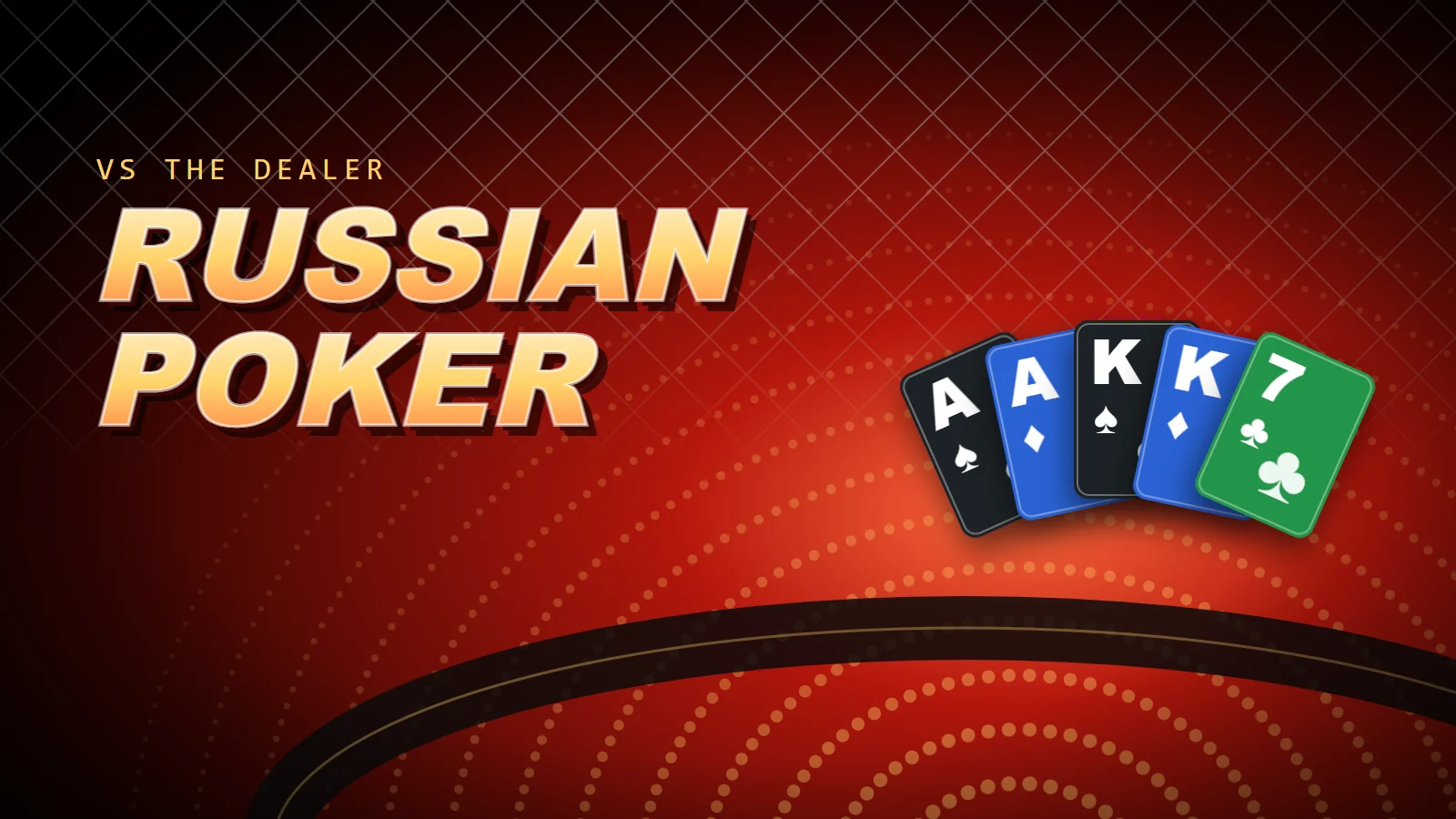


Russian Poker: Rules, Payouts, Odds and Strategy (2026)
Russian poker is a casino table game, not a game against other players: you and the dealer each get five cards, and you can pay to swap cards, buy a sixth card or even buy a hand for the dealer. It has more decisions than most casino stud games — and, like every casino game, a built-in house edge. Here are the rules, the typical payouts, the odds and the strategy basics.
Updated: 20 October 2026- In Russian poker you play against the dealer: you post an ante, get five cards and decide to fold, bet, exchange cards or buy a sixth card.
- The dealer qualifies with Ace-King or better. If the dealer doesn’t qualify, you are usually paid 1:1 on the ante and your bet is returned.
- If the dealer qualifies and you win, the ante pays 1:1 and the bet pays by the payout table — from 1:1 for a pair up to around 100:1 for a royal flush (tables vary).
- Extras like buying a game for the dealer, insurance and paying two combinations depend on the casino. The house always keeps an edge.
What is Russian poker
Russian poker (also called Russian stud) is a banked casino game based on five-card stud. There is no bluffing and no other players to beat: every seat at the table plays its own hand against the dealer’s hand. It became popular in Russian casinos in the 1990s and spread to Europe and online casinos as a richer version of Caribbean stud poker.
The hand rankings are the usual poker ones — see our poker hand rankings. What makes Russian poker special is the number of options: you can pay to exchange cards, buy a sixth card, and if the dealer has no qualifying hand you can buy a game for the dealer to get your strong hand paid.
Russian poker rules step by step
- 1You place an ante within the table limits.
- 2You and the dealer each get five cards. In most versions one of the dealer’s cards is dealt face up, the other four face down.
- 3You look at your cards and choose: fold (you lose the ante), bet (usually twice the ante), exchange cards or buy a sixth card — the last two cost an extra ante each.
- 4After an exchange or a sixth card you decide again: bet or fold.
- 5The dealer reveals the hand. If it is weaker than Ace-King, the dealer doesn’t qualify: you are paid on the ante and the bet is returned (or you can buy a game — see below).
- 6If the dealer qualifies, the hands are compared. A better hand wins 1:1 on the ante plus the bet multiplied by the payout table; a worse hand loses both; a tie returns the stakes.
| Situation | Ante | Bet |
|---|---|---|
| You fold | Lost | — |
| Dealer doesn’t qualify | Paid 1:1 | Returned |
| Dealer qualifies, you win | Paid 1:1 | Paid by the payout table |
| Dealer qualifies, dealer wins | Lost | Lost |
| Tie | Returned | Returned |
When the dealer qualifies: Ace-King or better
The dealer’s hand “has a game” when it holds at least Ace and King — a hand with no pair but with an ace and a king, or any pair or better. Anything weaker, such as A-Q-high or K-Q-high, does not qualify.
In a five-card hand the dealer qualifies roughly 56% of the time and fails to qualify about 44% of the time. That 44% is why weak hands are sometimes worth a bet: if the dealer has no game you still collect the ante.
Exchanging cards and buying a sixth card
These two options are the heart of Russian poker. Both cost you an extra stake (usually one ante) that is not returned, so they only make sense when they improve your expected result.
Whether you can both exchange and buy a sixth card in the same hand, and how many cards you may swap, differs by casino. Approximate chances when drawing (the dealer’s cards are unknown, so these are close estimates):
| You hold | Draw | Chance to improve |
|---|---|---|
| Four to a flush | 1 card | ≈19% (9 outs of 47) |
| Four to an open-ended straight | 1 card | ≈17% (8 outs of 47) |
| Four to a gutshot straight | 1 card | ≈8.5% (4 outs of 47) |
| One pair | 3 cards | ≈29% to two pair or better (≈11% to trips) |
| Two pair | 1 card | ≈8.5% to a full house (4 outs of 47) |
Buying a game for the dealer
If you have a strong hand and the dealer doesn’t qualify, you only get the ante back with a 1:1 win — the big payout on your bet is lost. To avoid that, many casinos let you buy a game for the dealer: you pay an extra stake (usually equal to the ante), and the dealer replaces one card — typically the highest — with a new one, or draws an extra card, depending on the rules.
- If the dealer now qualifies and you still have the better hand, your bet is paid by the payout table.
- If the new card makes the dealer’s hand better than yours, you lose the ante and the bet.
- If the dealer still has no game, the exact outcome depends on the house rules — the money paid for buying the game is usually not returned.
Insurance in Russian poker
Some casinos offer insurance for players holding a strong hand. Its exact form varies: most often it is a side stake that pays if the dealer doesn’t qualify, so a big hand is not left with only the ante payout. The maximum insurance is usually limited (for example, a share of the possible win on the bet), and if the dealer does qualify, the insurance stake is lost.
Insurance is a separate wager with its own edge for the house. Use it only if you understand the specific casino’s rules — it does not change the odds of the main hand.
Russian poker hands and payout table
Your bet is paid according to your combination. A typical table is below — the exact multipliers, especially for the flush and the top hands, differ between casinos, and many tables also set a maximum payout per hand.
| Combination | Typical payout on the bet |
|---|---|
| Ace-King | 1:1 |
| One pair | 1:1 |
| Two pair | 2:1 |
| Three of a kind | 3:1 |
| Straight | 4:1 |
| Flush | 5:1 (sometimes 6:1) |
| Full house | 7:1 |
| Four of a kind | 20:1 |
| Straight flush | 50:1 |
| Royal flush | 100:1 |
Two combinations and bonuses
A feature of many Russian poker tables is paying two combinations at once — for example, when six cards (after buying a sixth card) contain two different hands. Some casinos also pay extra bonuses for top hands regardless of the dealer’s hand. These rules are not universal, so check the table’s help screen before you play.
Odds of each hand
These are the chances of being dealt each combination in five cards from a 52-card deck, before any exchange. They explain the payout table: the rarer the hand, the bigger the multiplier.
| Combination | Chance in 5 cards | About 1 in |
|---|---|---|
| Royal flush | 0.00015% | 649,740 |
| Straight flush | 0.0014% | 72,193 |
| Four of a kind | 0.024% | 4,165 |
| Full house | 0.14% | 694 |
| Flush | 0.20% | 509 |
| Straight | 0.39% | 255 |
| Three of a kind | 2.1% | 47 |
| Two pair | 4.75% | 21 |
| One pair | 42.3% | 2.4 |
| No pair | 50.1% | 2 |
In other words, about half of all hands have no pair at all. The decisions you make with those hands — fold, bet, exchange — have the biggest effect on your results.
Russian poker strategy basics
There is no strategy that beats the house over the long run, but good decisions reduce how much you lose. The general principles agreed on by most guides:
- Common mistakes
- Exchanging cards with hands that have no realistic draw.
- Buying a game for the dealer with a single pair.
- Taking insurance without knowing what it pays and when.
- Chasing losses with bigger antes.
Russian poker vs Texas Hold’em and classic poker
The name says poker, but the game is very different from what you play in poker clubs and poker rooms.
| Russian poker | Texas Hold’em | Classic five-card draw | |
|---|---|---|---|
| Opponent | The dealer (the casino) | Other players | Other players |
| Cards | 5 private cards (6 with a bought card) | 2 hole cards + 5 community cards | 5 private cards |
| Bluffing | Not possible | A key part of the game | Part of the game |
| Drawing cards | For a fee (one ante) | No | Free, one draw |
| Who pays winners | The casino, by a payout table | Other players, from the pot | Other players, from the pot |
| Long-term edge | Always the house | Better players | Better players |
In Texas Hold’em and Omaha you win money from other players, and skill decides the long-term result; the operator takes only a rake. In Russian poker the casino is your opponent and its edge is built into the payout table. If you want to learn real poker, start with our poker rules and the beginner guide.
Where to play Russian poker online
Russian poker is offered by some online casinos, as a software (RNG) game and sometimes with a live dealer. Many casino games of this type have a demo mode with play money, so you can learn the rules for free; whether you need an account for it depends on the site. Real-money play is legal only where online casinos are allowed and only for adults.
- Before you play for money
- Check that online casino games are legal in your country.
- Read the table rules: bet size, exchange cost, sixth card, buying a game, insurance and the payout table.
- Look for the maximum payout per hand — a royal flush may be capped.
- Try the demo mode first to learn the decisions without risk.
- Set a budget you are ready to lose and stop when it is spent.
House edge and responsible play
Every payout in Russian poker is set slightly below the true odds, so over many hands the casino wins. The exact house edge depends on the rules and payout table of the specific game, and the extra options (exchange, sixth card, buying a game, insurance) each cost money. Short-term wins happen — that is variance, not a system.
Poker against players: ClubGG clubs
If you prefer a game where skill can beat the opponents, here are the top ClubGG clubs from our catalog, ranked by player reviews. Each club page lists games, rake and rakeback.


FAQ
01What is Russian poker?
A casino table game based on five-card stud. You play against the dealer, not other players, and you can pay to exchange cards, buy a sixth card or buy a game for the dealer.
02When does the dealer qualify in Russian poker?
With Ace-King or better: any hand with an ace and a king, or any pair or higher combination. Weaker hands do not qualify.
03What happens if the dealer doesn’t qualify?
Usually you are paid 1:1 on the ante and your bet is returned. Many casinos let you buy a game for the dealer to try to get your full bet paid.
04How much does a royal flush pay?
On a typical table 100:1 on the bet, but payouts differ between casinos and there is often a maximum payout per hand.
05Can you exchange cards in Russian poker?
Yes, for a fee (usually one ante) you can replace one to five cards, normally once per hand. You can also buy a sixth card instead, depending on the rules.
06Is Russian poker the same as Texas Hold’em?
No. Hold’em is played between players with community cards and bluffing; Russian poker is a game against the casino with five private cards and a payout table.
07Can you play Russian poker online for free?
Some online casinos have a demo mode with play money. Whether registration is required depends on the site. Real-money play is only for adults where it is legal.
08Can you win at Russian poker in the long run?
No — the house edge is built into the payouts. Good decisions reduce losses, but no strategy guarantees a profit.
Read next
 How to Play Poker Online with Friends: Your Own ClubGG Club and a No-Rake Table (2026)Read
 Triton Poker: the Super High Roller Series Explained (2026)Read
 Poker Calculator: Free Odds, Equity, ICM and Bankroll Tools Explained (2026)Read
 Famous Poker Players: Legends, the “King of Poker” and Today’s StarsRead
 History of Poker: Where the Word Comes From, How the Game Spread and the Moneymaker EffectRead



 Poker on Android: The Best Apps and How to Play on Your PhoneRead