Poker Rules for Beginners: How to Play Texas Hold’em Step by Step
Poker looks complicated from the outside, but a Texas Hold’em hand follows the same simple script every time: two forced bets, two cards each, five shared cards and four rounds of betting. This guide walks you through the rules in the order you meet them at the table, with a full example hand, the classic five-card draw game and the mistakes that cost beginners the most.
Updated: 19 October 2026- The goal is to win chips: either show the best five-card hand at the end, or make everyone else fold.
- Each player gets 2 private cards; up to 5 shared cards are dealt in three steps — flop (3), turn (1), river (1).
- There are four betting rounds: preflop, flop, turn and river. On your turn you can check, bet, call, raise or fold.
- Two players post forced bets every hand — the small and big blind — and the dealer button moves one seat clockwise after each hand.
What poker is and what you’re trying to do
Poker is a card game where players bet chips on who has the best hand. You don’t play against the house: chips move between players, and a hand ends in one of two ways — everyone but one player folds, or two or more players reach the showdown and the best hand takes the pot.
That second way is why poker is a game of skill as well as luck: you can win a pot with the worst cards if your bets make opponents give up, and you can lose little with a bad hand by folding early. Texas Hold’em is the most popular form, and it’s what this guide covers first; the classic five-card draw game is explained further down.
If you’re playing at home with a real deck, you also need a dealer button (any token works) to mark whose turn it is to deal. Before each hand the deck is shuffled, and before dealing each street the dealer “burns” one card face down so nobody can see the next card by accident.
Button, blinds and positions
The button marks the nominal dealer. The two players to its left post forced bets before any cards are dealt: the small blind (usually half the big blind) and the big blind. Blinds make sure there’s always something to play for. After each hand the button moves one seat clockwise, so everyone pays the blinds in turn.
| Position | Where it is | What it means |
|---|---|---|
| Button (BTN) | The dealer seat | Acts last on the flop, turn and river — the best seat |
| Small blind (SB) | First to the left of the button | Posts half a big blind; acts first after the flop |
| Big blind (BB) | Second to the left | Posts one big blind; acts last preflop |
| Under the gun (UTG) | Left of the big blind | Acts first preflop — the hardest seat |
| Middle position (MP) | Next seats clockwise | Acts in the middle |
| Cutoff (CO) | Right of the button | Second-best seat |
Acting later is a real advantage: you see what everyone before you did. That’s why good players play more hands on the button and fewer under the gun. Tournaments and many club tables also add an ante — a small forced bet from every player.
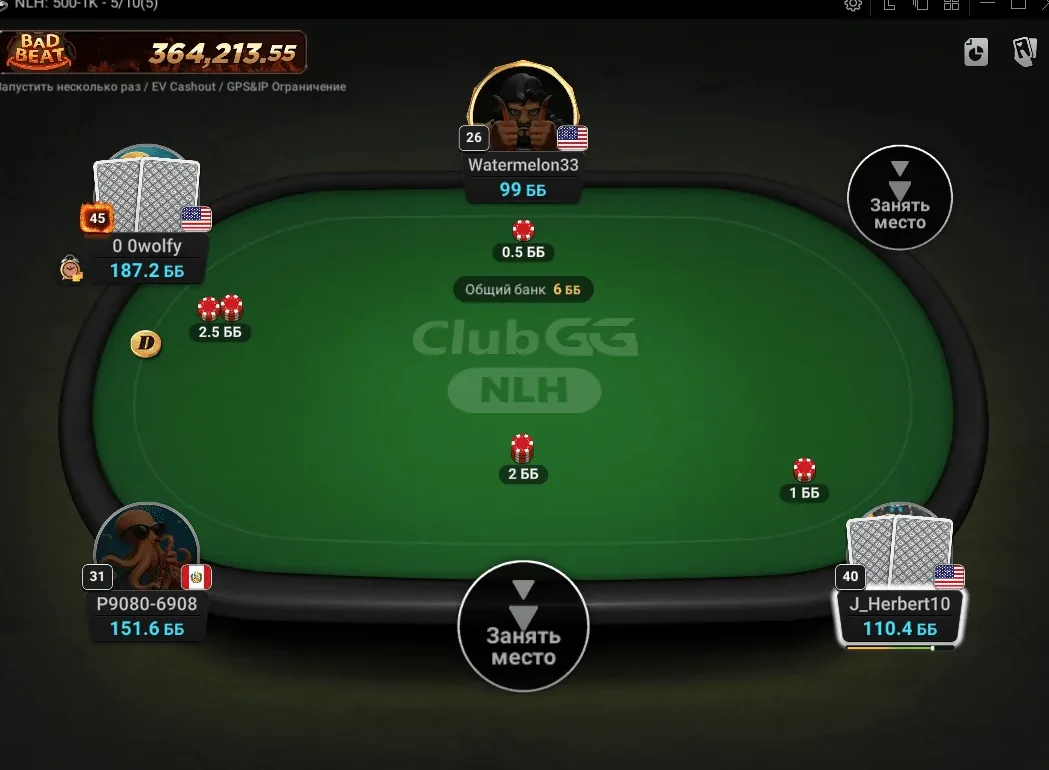
How a hand is played, step by step
- 1Blinds. The small and big blind put their chips in before the deal.
- 2Deal. Starting with the small blind, everyone gets two cards face down — your hole cards. Only you see them.
- 3Preflop. The first player left of the big blind acts first; action goes clockwise. To stay in you must at least call the big blind.
- 4Flop. Three community cards are dealt face up. A new betting round begins with the first active player left of the button.
- 5Turn. The fourth community card, and another betting round.
- 6River. The fifth and last community card, and the final betting round.
- 7Showdown. If two or more players are left, they show their cards. The best five-card hand out of each player’s 2 + 5 cards wins the pot.
A betting round ends when everyone still in the hand has put in the same amount (or is all-in) and everyone has had a chance to act. If everyone folds to one player at any point, that player wins the pot immediately and doesn’t have to show.
Your options: check, bet, call, raise, fold, all-in
| Action | When you can | What it does |
|---|---|---|
| Check | Nobody has bet yet in this round | Pass without putting in chips; you stay in the hand |
| Bet | Nobody has bet yet | Put the first chips into the pot this round |
| Call | Someone has bet | Match the current bet |
| Raise | Someone has bet | Increase the bet; others must call the new amount or fold |
| Fold | Any time it’s your turn | Give up the hand and everything you’ve put in |
| All-in | Any time it’s your turn | Bet all your chips; you can’t be forced out of the hand after that |
You can’t check once someone has bet — your choices are call, raise or fold. In No-Limit games a raise must be at least as big as the previous bet or raise: if the big blind is 2 and someone raises to 6 (4 more), the next raise must be to at least 10.
Betting limits
How much you may bet depends on the game format. No-Limit — any amount up to your whole stack; this is the standard for Hold’em. Pot-Limit — up to the size of the pot; standard for Omaha. Fixed-Limit — fixed bet sizes per round. More on the formats in our Texas Hold’em guide.
Showdown, ties and side pots
At showdown the player who made the last bet or raise on the river shows first; if everyone checked the river, the first player left of the button shows first. Others can show a winning hand or give up without showing. In apps it all happens automatically, and the app announces each player’s hand.
Hands are compared by the standard ranking — see poker hand rankings with pictures. You may use both of your hole cards, one, or none. If two hands are identical, the pot is split.
Side pots
A player who goes all-in can only win as much from each opponent as they put in. Any extra betting between the other players goes into a separate side pot.
| Step | Player A (50 chips) | Player B (200) | Player C (200) |
|---|---|---|---|
| Preflop | All-in 50 | Calls 50 | Calls 50 |
| Main pot | 150 chips — all three can win it | ||
| Flop | — | Bets 100 | Calls 100 |
| Side pot | 200 chips — only B and C can win it |
If A has the best hand, A wins the 150-chip main pot, and the side pot goes to whichever of B and C has the better hand. Apps build side pots for you, but knowing how they work stops arguments in home games.
A full example hand
Six players, blinds 1/2, everyone has 200 chips. You are on the button.
Preflop. UTG folds, the middle-position player (MP) raises to 6, the cutoff folds. You call 6. The small blind folds, the big blind calls (4 more). Pot: 6 + 6 + 6 + 1 from the small blind = 19.
The big blind checks, MP bets 10, you call, the big blind folds. Pot: 39.
MP checks, you bet 25, MP calls. Pot: 89.
MP checks, you bet 60, MP calls. Pot: 209. You bet last on the river, so you show first.
You win the 209-chip pot (before any rake). Notice that you used both hole cards here; on another board your best hand might have used one or none.
Classic poker: five-card draw rules
Before Hold’em took over, “poker” mostly meant five-card draw — the game from old films, and still a common home game. The hand rankings are exactly the same, but there are no community cards.
- 1Everyone posts an ante (or the two players left of the button post blinds).
- 2Each player gets five cards face down.
- 3First betting round, starting left of the big blind (or left of the dealer if only antes are used).
- 4The draw: in turn, each remaining player discards any number of cards — from none to all five — and gets the same number of new ones. Many home rules limit the draw to three cards, or four if you keep an ace.
- 5Second betting round, then showdown: the best five-card hand wins.
| Texas Hold’em | Five-card draw | |
|---|---|---|
| Cards per player | 2 private | 5 private |
| Community cards | 5 | None |
| Changing cards | No | Yes, once |
| Betting rounds | 4 | 2 |
| What you can read | Board texture and betting | Mostly betting and how many cards opponents drew |
Some home games add “jacks or better” — you need at least a pair of jacks to open the betting. Another old form, five-card stud, deals one card face down and four face up with betting after each, without any draw.
How to play poker with two people
Heads-up (one-on-one) uses the same rules with one twist in the blinds: the button posts the small blind, the other player posts the big blind.
- The first card is dealt to the big blind, the second to the button, and so on.
- Preflop the button (small blind) acts first, the big blind acts last.
- After the flop the big blind acts first, the button acts last — as in a full game.
- The button changes every hand, so you alternate blinds.
Heads-up you play far more hands than at a full table — top pair and even ace-high are often good. It’s a fast way to learn, and club apps let you open a private table for two; see how to play poker online with friends.
Table etiquette
- Act only in turn, even if you’ve already decided to fold.
- Say “raise” before you move chips, or put the whole raise in one motion — adding chips in several moves (a string bet) may count only as a call.
- Don’t throw chips into the pot loosely; stack your bet in front of you.
- Don’t talk about your hand or the board while the hand is still going on, even if you’ve folded.
- When called on the river, show your hand without stalling — a slow roll is considered rude.
- Online: don’t burn the timer on easy decisions and keep the chat friendly.
Beginner mistakes to avoid
How to learn poker from zero
- 1Memorise the hand rankings until you can name your hand instantly.
- 2Play a few dozen free hands with play chips to get used to the order of action — see where to play poker free.
- 3Learn a simple preflop plan: which hands to play from which seat. Our Texas Hold’em guide has a starter chart.
- 4Check spots with the equity calculator; for short stacks use the push-fold charts.
- 5Move to the lowest real-money stakes or freerolls when you’re ready, and keep learning — our learning roadmap lists the next steps.
FAQ
01How many cards does each player get in Texas Hold’em?
Two private cards. Then five community cards are dealt: three on the flop, one on the turn, one on the river.
02How many people can play poker?
Hold’em is played by 2 to 10 players at one table. Online tables are usually 6-max or 9-max.
03Who acts first in poker?
Preflop, the player to the left of the big blind. On the flop, turn and river, the first player still in the hand to the left of the button.
04What are blinds?
Forced bets posted by the two players to the left of the button before the deal: the small blind and the big blind. They rotate every hand.
05Can I check after someone bets?
No. Once there’s a bet you can only call, raise or fold.
06What happens if I don’t have enough chips to call?
You can go all-in for what you have. You can then win only the part of the pot you matched; the rest forms a side pot between the other players.
07What if two players have the same hand?
The pot is split equally. Only the best five cards count, so kickers are checked first.
08Can two people play poker?
Yes, heads-up. The button posts the small blind and acts first preflop, but last after the flop.
09What is classic poker?
Usually five-card draw: five private cards, one chance to swap some of them, two betting rounds and the same hand rankings as Hold’em.
10How long does it take to learn poker?
The rules take an evening. Playing well takes months of practice — start with free games and low stakes.
Read next




 Download Poker for Phone and PC: Official Apps OnlyRead Poker Freerolls: What They Are, Where to Find Them and How to WinRead How to Learn Poker from Scratch: A Step-by-Step Plan and Core StrategyRead Omaha Poker: Rules, Hand Rankings and How It Differs From Hold’emRead Online Poker Club: What It Is, How to Join and Choose OneRead
 Play Poker Online for Free (No Download, No Sign-up?): Where to Play for Play MoneyRead