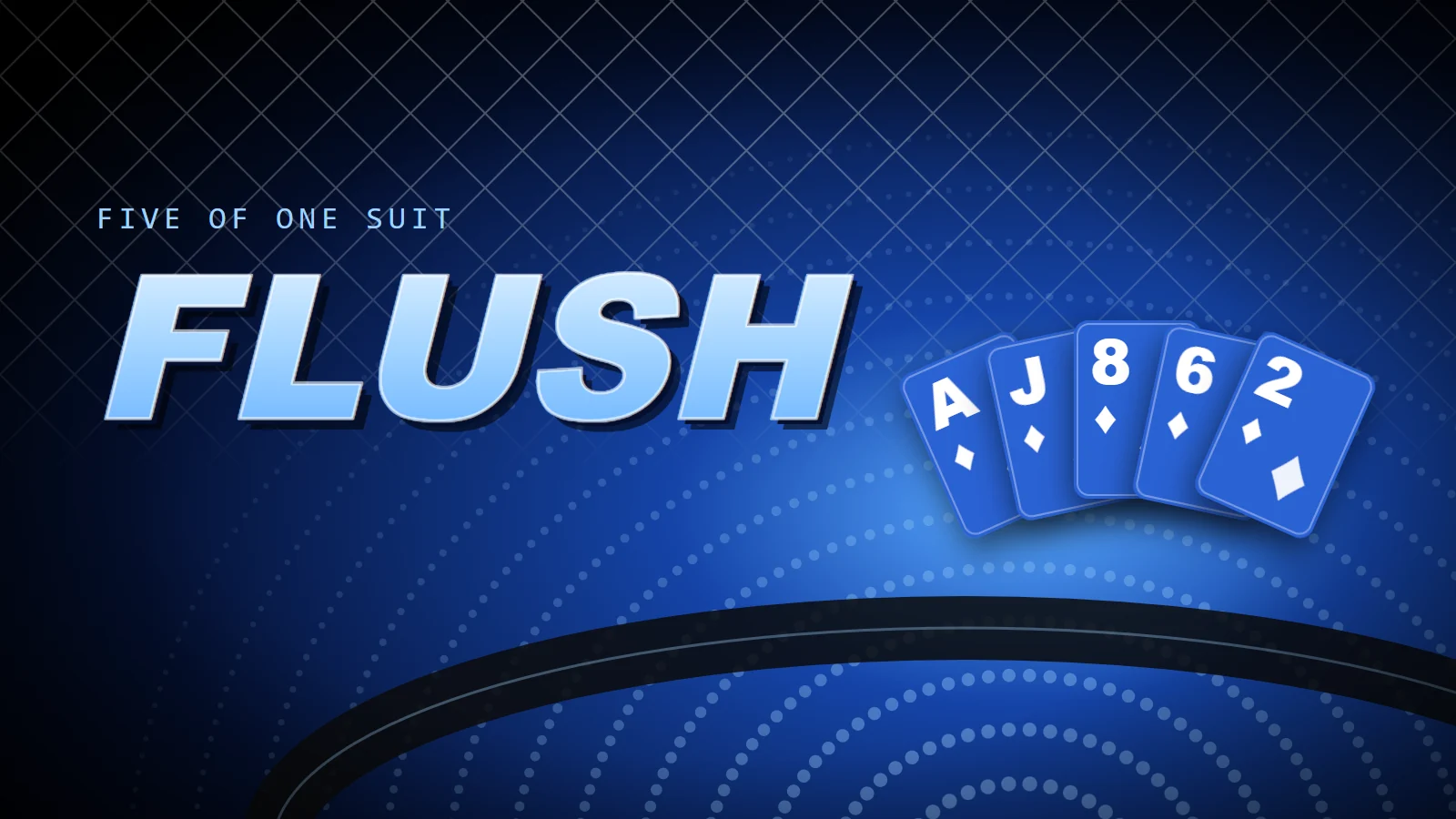



Flush in Poker: What It Is, What It Beats and How to Play Flush Draws
A flush is five cards of the same suit — simple to spot, but full of traps: which flush wins when two players have one, why the suit never matters, why a small flush on a four-heart board is often in trouble, and why in Omaha one heart in your hand makes nothing at all. Below: the rules with card pictures, flush draw maths and how to play them.
Updated: 20 October 2026- A flush is any five cards of one suit that are not in sequence. It ranks above a straight and below a full house.
- Two flushes are compared card by card from the top: highest card first, then the second, down to the fifth. Suits never break ties.
- A flush draw has 9 outs: about 35% to hit from flop to river and about 19% on the next card.
- In Omaha you must use exactly two hole cards — with one card of the suit in hand you have no flush. In Short Deck a flush beats a full house.
What is a flush in poker
A flush is a hand of five cards of the same suit — five spades, five hearts, five diamonds or five clubs — in any order. If the five cards also run in sequence, the hand is no longer a flush but a straight flush, which is much stronger. In the general poker hand rankings the flush is the fifth hand from the top.
In Texas Hold’em you build the best five-card hand from your two hole cards and five community cards. A flush can use both of your cards, one of them, or none — if all five board cards are of one suit, everyone still in the hand has at least that flush.
How flushes are compared: which flush wins
When two players both have a flush, compare the highest card of each. If they are equal, compare the second highest, then the third, the fourth and finally the fifth. The first difference decides the pot. Only if all five cards match in rank is the pot split.
With four cards of a suit on the board, the battle is often decided by a single card in hand:
Five suited cards on the board
| Situation | Who wins |
|---|---|
| Different top cards | The higher top card: A-7-5-4-2 beats K-Q-J-9-8 |
| Same top card | Compare the 2nd card, then the 3rd, 4th, 5th |
| Same five ranks | Split pot — suit doesn’t matter |
| Flush on the board, no better card in hand | Everyone who plays the board splits |
The nut flush
The nut flush is the best flush possible on a given board. Usually it’s the ace-high flush — the player holding the ace of the suit. If the ace is already on the board, the king of the suit makes the nut flush; if the ace and king are both on the board, the queen does, and so on.
Why it matters: when two flushes meet, the smaller one usually loses a big pot. Experienced players happily pay off with the nut flush and become careful with a 6-high or 8-high flush, especially against strong action.
Flush in the hand rankings: flush vs straight, full house and straight flush
A flush beats a straight, three of a kind, two pair, one pair and high card. It loses to a full house, four of a kind, a straight flush and a royal flush. The order follows rarity: of the 2,598,960 possible five-card hands, 5,108 are flushes and 10,200 are straights — a flush comes about half as often, so it ranks higher.
| Hand | Flush vs it | 5-card hands |
|---|---|---|
| Royal flush | Loses | 4 |
| Straight flush | Loses | 36 |
| Four of a kind | Loses | 624 |
| Full house | Loses (in Short Deck a flush wins) | 3,744 |
| Flush | Compare cards from the top | 5,108 |
| Straight | Wins | 10,200 |
| Three of a kind | Wins | 54,912 |
Straight flush and royal flush
If the five cards of one suit also form a sequence, the hand is a straight flush — the second-best hand in poker. The highest straight flush, A-K-Q-J-10 of one suit, is the royal flush, the best hand of all. Straight flushes are compared like straights — by the top card.
Read more about straights — including the wheel and why Q-K-A-2-3 is not a straight — in our guide to the straight in poker.
Flush probability
In a random five-card deal a flush (not counting straight flushes) comes up about 0.197% of the time — roughly once in 509 deals. In Hold’em you choose the best five out of seven cards, so flushes are far more common: about 3.03% of all hands end with a flush as the best hand.
| Hand | 5-card deal | Best of 7 cards (Hold’em) |
|---|---|---|
| Royal flush | 0.000154% | 0.0032% |
| Straight flush (excl. royal) | 0.00139% | 0.028% |
| Full house | 0.144% | 2.60% |
| Flush | 0.197% (≈ 1 in 509) | 3.03% (≈ 1 in 33) |
| Straight | 0.392% | 4.62% |
| Hold’em situation | Chance |
|---|---|
| Being dealt two suited cards | ≈ 23.5% |
| Suited cards: flopping a flush | ≈ 0.84% |
| Suited cards: flopping a flush draw (two of your suit) | ≈ 10.9% |
| Suited cards: a flush by the river | ≈ 6.5% |
| Unsuited cards: a flush by the river | ≈ 2% |
The takeaway: suited cards add a few percent of equity, not a miracle. A hand like 9♠ 4♠ is still a weak hand — it makes a flush only about once in 15 times.
Flush draws: outs and odds
A flush draw is four cards of one suit after the flop or turn, waiting for a fifth. A suit has 13 cards; four are already in your hand and on the board, so 9 cards complete the flush — these are your outs.
| Draw | Outs | Next card | Flop → river (two cards) |
|---|---|---|---|
| Flush draw | 9 | ≈ 19% (flop), ≈ 19.6% (turn) | ≈ 35% |
| Flush draw + gutshot | 12 | ≈ 25.5% | ≈ 45% |
| Flush draw + open-ended straight draw | 15 | ≈ 32% | ≈ 54% |
| Backdoor flush draw (three of a suit) | — | — | ≈ 4% |
A quick way to estimate is the rule of 4 and 2: multiply your outs by 4 on the flop (two cards to come) and by 2 on the turn (one card to come). For a flush draw: 9 × 4 = 36% and 9 × 2 = 18% — close to the exact 35% and 19.6%. For exact equity against a specific hand use the equity calculator.
Backdoor flush draws
A backdoor flush draw means you have three cards of a suit after the flop and need both the turn and the river to be that suit. The chance is about 4.2% (10/47 × 9/46). On its own that’s small, but it adds a little equity to hands that have something else and gives you more good turn cards to keep betting.
If a spade comes on the turn, the backdoor draw becomes a real flush draw with 9 outs and about 19.6% to hit on the river.
How to play a flush draw
A flush draw is usually behind a made hand like top pair, but it has a lot of equity. There are two ways to play it: passively (check and call when the price is right) or aggressively (bet or raise as a semi-bluff).
Pot odds for a flush draw
Pot odds show how much equity you need to call profitably: call ÷ (pot after your call). Example on the turn: the pot is 100, the opponent bets 50. You call 50 to win 150, so you need 50 ÷ 200 = 25%. A flush draw has 19.6% — not enough on its own. The call only works if you expect to win roughly another 105 or more on the river when you hit (implied odds).
| Opponent’s bet | Equity needed to call | Flush draw on the turn (19.6%) | Flush draw all-in on the flop (35%) |
|---|---|---|---|
| 1/3 pot | 20% | Almost enough | Easy call |
| 1/2 pot | 25% | Not enough without implied odds | Call |
| 2/3 pot | 28.6% | Not enough | Call |
| Pot | 33.3% | Not enough | Close, slightly profitable |
- 1Count your outs: 9 for a flush draw, more if you also have a straight draw or overcards.
- 2Convert to a chance: about 35% with two cards to come (only if you are all-in or will see both cards), about 19% with one card.
- 3Compare it with the equity the bet requires (table above).
- 4If the price is too high, decide whether a semi-bluff raise or implied odds make up the difference — or fold.
More on equity, pot odds and EV — in our guide how to win at poker; the terms are explained in the poker glossary.
Four-flush boards: when your flush is in danger
When four cards of one suit are on the board, anyone holding a single card of that suit has a flush. Your hand can still be a flush — but now the question is how high your one suited card is.
- Typical mistakes on four-flush boards
- Calling big river bets with a low flush made by one small suited card.
- Ignoring that the board flush plays for everyone — with no card of the suit you can only hope for a split.
- Overplaying the ace of the suit on a paired board, where full houses are possible.
- Bluffing into several opponents on a four-flush board — someone often has a heart.
- What to do instead
- Value bet with the nut or second-nut flush card.
- With a medium flush, prefer checking and calling smaller bets.
- With a low flush or no suited card, fold to strong action.
Flush in Omaha: you must use two hole cards
In Omaha you have four (or more) hole cards, and your hand must use exactly two hole cards and exactly three board cards. This rule changes flushes completely: you need two cards of the suit in your hand and three on the board.
| Board | Hearts in your hand | Flush? |
|---|---|---|
| Three hearts | Two | Yes |
| Three hearts | One | No |
| Four or five hearts | One | No — the classic Omaha mistake |
| Two hearts | Three or four | No — only three board cards can play |
Because players see many combinations at once, flushes in Omaha are much more common than in Hold’em, and the nut flush matters more: a king-high flush that would be strong in Hold’em often loses in a multiway Omaha pot. Holding the ace of a suit also works as a blocker — no one else can have the nut flush in that suit.
Flush in Short Deck: a flush beats a full house
Short Deck (6+ Hold’em) is played with 36 cards — the twos through fives are removed. Each suit has only nine cards, so flushes become harder to make than full houses. That’s why in Short Deck a flush beats a full house.
Flush draws are weaker in Short Deck: with only nine cards per suit, a flush draw has 5 outs instead of 9 — about 30% from flop to river. The flush itself is strong, the draw is not.
Practise in club apps
Hold’em, Omaha and Short Deck tables run in ClubGG, PPPoker, PokerBros and other club apps. Below are ClubGG clubs from our catalog, ranked by player reviews.





FAQ
01What is a flush in poker?
Five cards of the same suit that are not in sequence, for example A-J-8-6-3 of diamonds. If they are in sequence, it’s a straight flush.
02Does a flush beat a straight?
Yes. A flush beats a straight in every common poker variant, because a flush is rarer: 5,108 five-card flushes against 10,200 straights.
03Which flush wins if two players have one?
Compare the highest card, then the second, third, fourth and fifth. The first higher card wins. If all five ranks are the same, the pot is split.
04Does the suit matter when comparing flushes?
No. In Hold’em and Omaha suits have no ranking — a spade flush and a heart flush with the same ranks split the pot.
05How many outs does a flush draw have?
Nine. With two cards to come you hit about 35% of the time, with one card to come about 19–20%.
06Can I make a flush with one heart in Omaha?
No. In Omaha you must use exactly two hole cards, so you need two cards of the suit in your hand and three on the board.
07Does a flush beat a full house?
Not in regular Hold’em or Omaha — a full house wins. In Short Deck (36 cards) the order is reversed and a flush beats a full house.
08How often do you make a flush in Hold’em?
About 3% of hands end with a flush as the best hand. With suited hole cards you make a flush by the river roughly 6.5% of the time.
Read next

 How to Play Poker Online with Friends: Your Own ClubGG Club and a No-Rake Table (2026)Read
 Triton Poker: the Super High Roller Series Explained (2026)Read
 Poker Calculator: Free Odds, Equity, ICM and Bankroll Tools Explained (2026)Read
 Famous Poker Players: Legends, the “King of Poker” and Today’s StarsRead
 History of Poker: Where the Word Comes From, How the Game Spread and the Moneymaker EffectRead


 Poker on Android: The Best Apps and How to Play on Your PhoneRead