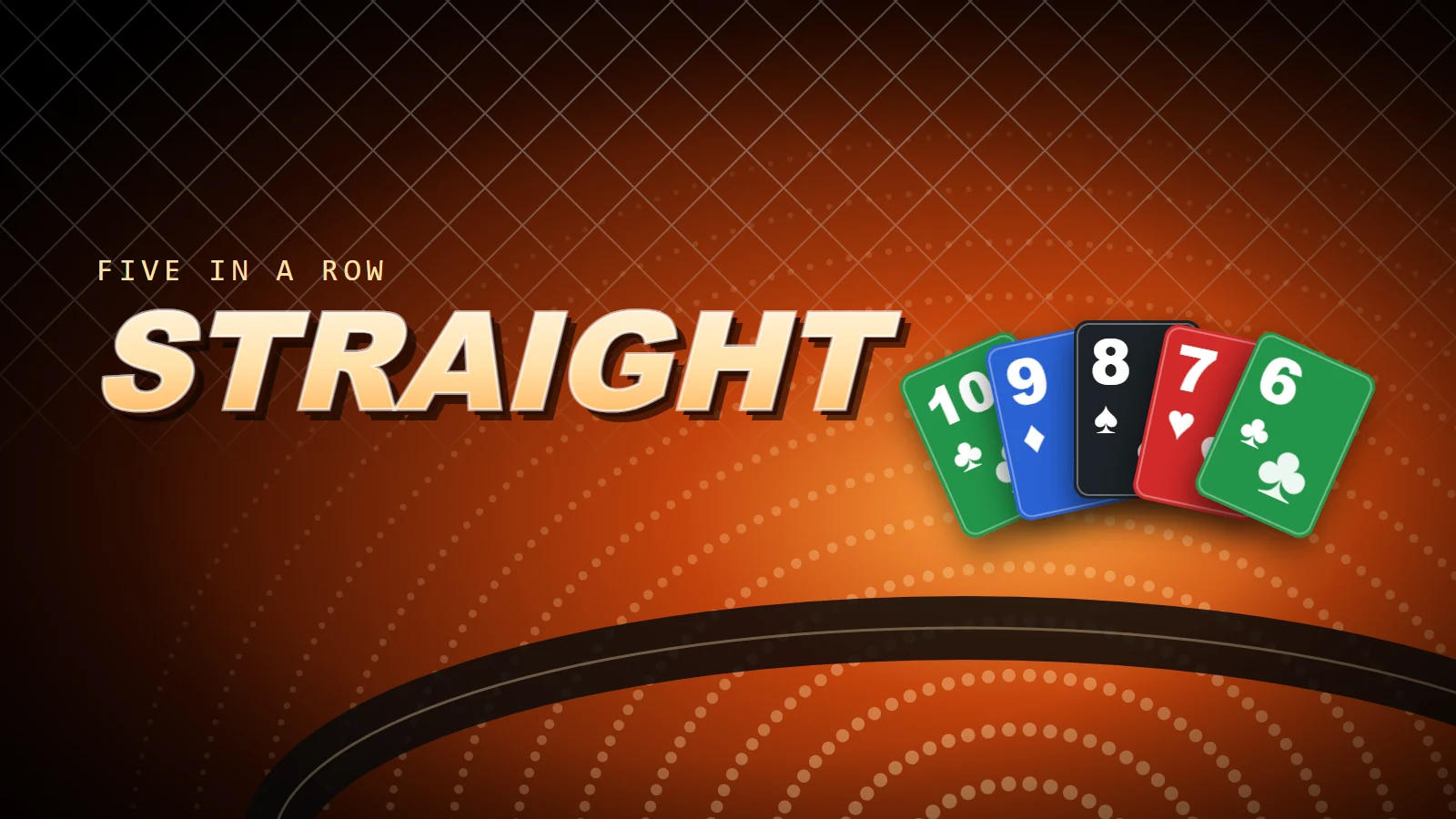



Straight in Poker: Rules, the Ace, Straight Draws and Odds
A straight is five cards in a row — 10-9-8-7-6 or A-K-Q-J-10. The rules look simple, but beginners trip over the ace, straights on the board, the “dummy end” and Omaha, where a straight on the board may give you nothing. Below: the rules with card pictures, how to count straight draws and how to play them.
Updated: 20 October 2026- A straight is five cards of consecutive rank, of mixed suits. It ranks above three of a kind and below a flush.
- The ace plays high (A-K-Q-J-10, Broadway) or low (5-4-3-2-A, the wheel), but straights never wrap around: Q-K-A-2-3 is not a straight.
- Straights are compared by the top card only; equal straights split the pot.
- An open-ended draw and a double gutshot have 8 outs (≈ 31.5% flop to river), a gutshot has 4 (≈ 16.5%). In Omaha a wrap can have up to 20 outs.
What is a straight in poker
A straight is five cards of consecutive rank that are not all of the same suit, for example 10-9-8-7-6. Suits don’t matter as long as they are mixed; if all five cards are of one suit, the hand is a straight flush instead. In the poker hand rankings the straight is sixth from the top — between the flush and three of a kind.
In Texas Hold’em a straight can use both hole cards, one of them or none at all. The most common case is one or two of your cards connecting with three or four on the board.
The ace in a straight: Broadway, the wheel and no wrap-around
The ace is the only card that can play both high and low. At the top it makes Broadway — A-K-Q-J-10, the best possible straight. At the bottom it makes the wheel (also called the bicycle) — 5-4-3-2-A, the worst straight, which loses to 6-5-4-3-2.
What the ace can’t do is sit in the middle. Straights don’t wrap around: Q-K-A-2-3, K-A-2-3-4 and J-Q-K-A-2 are not straights — they are just ace-high hands.
| Straight | Cards | Name |
|---|---|---|
| Ace-high | A-K-Q-J-10 | Broadway — the highest |
| King-high | K-Q-J-10-9 | — |
| Queen-high … six-high | Q-J-10-9-8 … 6-5-4-3-2 | — |
| Five-high | 5-4-3-2-A | The wheel — the lowest |
| Not a straight | Q-K-A-2-3, K-A-2-3-4 | No wrap-around |
How straights are compared
When two players have a straight, the one with the higher top card wins. There are no kickers: a straight is always exactly five cards. If both straights have the same top card, the pot is split — suits don’t matter.
| Situation | Who wins |
|---|---|
| Different top cards | The higher top card: 8-high beats 7-high |
| Same top card | Split pot |
| Six cards in a row available | Only the best five count: 4-5-6-7-8-9 is a nine-high straight |
| Straight on the board, nothing better in hand | Everyone who plays the board splits |
Straight vs three of a kind and flush: what beats what
A straight beats three of a kind, two pair, one pair and high card. It loses to a flush, full house, four of a kind, straight flush and royal flush. The order follows rarity: of 2,598,960 five-card hands there are 10,200 straights, 54,912 three-of-a-kinds and only 5,108 flushes.
If the five cards are also of one suit, it’s a straight flush, and A-K-Q-J-10 of one suit is a royal flush — the two strongest hands in poker. Why a flush ranks above a straight, and how flushes are compared, is explained in our guide to the flush in poker.
Straight probability
In a random five-card deal a straight (not counting straight flushes) comes up about 0.39% of the time — roughly once in 255 deals. In Hold’em, where you pick the best five of seven cards, about 4.62% of hands end with a straight as the best hand — roughly once in 22.
| Hand | 5-card deal | Best of 7 cards (Hold’em) |
|---|---|---|
| Flush | 0.197% | 3.03% |
| Straight | 0.392% (≈ 1 in 255) | 4.62% (≈ 1 in 22) |
| Three of a kind | 2.11% | 4.83% |
| Two pair | 4.75% | 23.5% |
With connected hole cards the numbers improve, but not dramatically. A hand like 8-7 flops a straight only about 1.3% of the time — it needs one of four flops: 4-5-6, 5-6-9, 6-9-10 or 9-10-J.
Straight draws: open-ended, gutshot and double gutshot
A straight draw is four cards that need one more to make a straight. How many cards complete it — your outs — depends on the type of draw.
Open-ended straight draw: 8 outs
Four consecutive cards open at both ends: either the card above or the card below completes the straight. Four of each rank means 8 outs.
Gutshot (inside straight draw): 4 outs
One card is missing from the middle of the straight, so only one rank completes it — 4 outs.
Double gutshot: 8 outs
Two different inside draws at once. It looks weaker than an open-ender, but it also has 8 outs — and it’s often better disguised.
| Draw | Outs | Next card | Flop → river (two cards) |
|---|---|---|---|
| Gutshot | 4 | ≈ 8.5% (flop), ≈ 8.7% (turn) | ≈ 16.5% |
| Open-ended | 8 | ≈ 17% (flop), ≈ 17.4% (turn) | ≈ 31.5% |
| Double gutshot | 8 | ≈ 17% / ≈ 17.4% | ≈ 31.5% |
| Gutshot + flush draw | 12 | ≈ 25.5% | ≈ 45% |
| Open-ended + flush draw | 15 | ≈ 32% | ≈ 54% |
The rule of 4 and 2 gives a fast estimate: outs × 4 on the flop, outs × 2 on the turn. An open-ender: 8 × 4 = 32%, a gutshot: 4 × 4 = 16%. For exact equity against a specific hand, use the equity calculator.
The nut straight and the dummy end
The nut straight is the highest straight possible on a given board. The dummy end (or “idiot end”) is the low end of a straight when a higher one is also possible. Holding the low end, you have a straight — and can still lose a big pot to a better one.
The same applies to draws. Not all outs of an open-ended draw are equally good:
- How to avoid the dummy end
- Before betting big, ask: which two cards make a higher straight than mine?
- Value draws to the top of the straight more than draws to the bottom.
- With the low end on a very connected board, prefer calling to raising.
How to play straight draws
A straight draw is usually behind a made hand, but it can win in two ways: by hitting, or by making the opponent fold. That’s why strong draws are often played as a semi-bluff — a bet or raise that can win now and still has outs when called.
Pot odds for straight draws
Divide the call by the pot after your call to get the equity you need. Facing a half-pot bet on the turn, you need 25% — an open-ender (17.4%) and a gutshot (8.7%) both fall short, unless you expect to win more on the river when you hit. On the flop, if you are all-in and see both cards, an open-ender’s 31.5% is enough against a bet of up to about three-quarters of the pot.
| Opponent’s bet | Equity needed | Open-ender, turn (17.4%) | Gutshot, turn (8.7%) |
|---|---|---|---|
| 1/4 pot | 16.7% | Call | Fold without implied odds |
| 1/3 pot | 20% | Close — implied odds decide | Fold without implied odds |
| 1/2 pot | 25% | Not enough on its own | Fold |
| Pot | 33.3% | Not enough | Fold |
EV, equity and pot odds are covered in more depth in how to win at poker, and terms like outs and semi-bluff in the poker glossary.
Straights in Omaha: two hole cards and wraps
In Omaha your hand must use exactly two hole cards and exactly three board cards. For straights this has two big consequences.
A straight on the board doesn’t count
Wraps: draws with up to 20 outs
With four hole cards you can hold several straight draws at once. A wrap is a draw where your hole cards surround the board cards, so many different ranks complete a straight. With four cards the biggest wrap on the flop has 20 outs.
| Turn card | Your straight | Nuts? |
|---|---|---|
| King | K-Q-J-10-9 (Q-J) | Yes |
| Queen | Q-J-10-9-8 (J-8) | No — K-J makes K-Q-J-10-9 |
| Jack | Q-J-10-9-8 (Q-8) | No — K-Q makes K-Q-J-10-9 |
| Eight | Q-J-10-9-8 (Q-J) | Yes |
| Seven | J-10-9-8-7 (J-8) | Yes |
| Six | 10-9-8-7-6 (8-7) | Yes |
So 14 of the 20 outs give the nut straight on the turn. With 45 unseen cards after the flop, a 20-out wrap hits on the next card about 44% of the time and by the river about 70% — one of the strongest draws in Omaha. Smaller wraps with 13–17 outs are also common. Remember that the board can still pair or bring a flush, so a made straight in Omaha is never guaranteed to hold.
Straight in Short Deck: A-6-7-8-9 and the trips rule
Short Deck (6+ Hold’em) uses a 36-card deck without twos, threes, fours and fives. The ace still plays low, but now it takes the place of the five: the lowest straight is A-6-7-8-9. That leaves six possible straights instead of ten.
Straight draws are much stronger in Short Deck: with only 31 unseen cards after the flop, an open-ender’s 8 outs hit about 45.6% of the time by the river, and a gutshot about 24.5%.
Tricky straight situations
- Common mistakes with straights
- Counting Q-K-A-2-3 or K-A-2-3-4 as a straight.
- Thinking you win with a straight on the board, when someone holds one card higher.
- Ignoring a flush draw or a paired board: a straight loses to flushes and full houses.
- Paying off big bets with the dummy end of a straight on a very connected board.
- Treating J-Q-K-A as an open-ended draw — only a ten completes it.
- In Omaha, using one hole card or four board cards for a straight.
Practise in club apps
Hold’em, Omaha and Short Deck tables run in ClubGG, PPPoker, PokerBros and other club apps. Below are ClubGG clubs from our catalog, ranked by player reviews.




FAQ
01What is a straight in poker?
Five cards of consecutive rank and mixed suits, for example 10-9-8-7-6. If all five are of one suit, it’s a straight flush.
02Is A-2-3-4-5 a straight?
Yes. It’s called the wheel — the lowest straight, five high. It loses to 6-5-4-3-2.
03Is Q-K-A-2-3 a straight?
No. Straights don’t wrap around the ace: the ace can only be the top (A-K-Q-J-10) or the bottom (5-4-3-2-A) of a straight.
04Does a straight beat three of a kind?
Yes, in Hold’em and Omaha. In Short Deck many rule sets put three of a kind above a straight, but some keep the classic order — check the table rules.
05What beats a straight?
A flush, full house, four of a kind, straight flush and royal flush.
06Which straight wins if two players have one?
The straight with the higher top card. If the top cards are equal, the pot is split — suits don’t matter.
07How many outs does an open-ended straight draw have?
Eight — four cards of each of the two ranks that complete it. That’s about 31.5% from flop to river. A gutshot has four outs, about 16.5%.
08What is a wrap in Omaha?
A straight draw where your four hole cards surround the board cards, so many ranks complete a straight. The biggest wraps have 20 outs on the flop.
Read next

 How to Play Poker Online with Friends: Your Own ClubGG Club and a No-Rake Table (2026)Read
 Triton Poker: the Super High Roller Series Explained (2026)Read
 Poker Calculator: Free Odds, Equity, ICM and Bankroll Tools Explained (2026)Read
 Famous Poker Players: Legends, the “King of Poker” and Today’s StarsRead
 History of Poker: Where the Word Comes From, How the Game Spread and the Moneymaker EffectRead


 Poker on Android: The Best Apps and How to Play on Your PhoneRead