




Omaha Poker: Rules, Hand Rankings and How It Differs From Hold’em
Omaha looks like Texas Hold’em with two extra cards — same blinds, same flop, turn and river. But one rule changes everything: you must use exactly two of your four cards. Hold’em players misread their hands for weeks because of it. Here are the rules, the classic misreads with card pictures, how pot-limit betting works and where to play Omaha online.
Updated: 19 October 2026- Each player gets 4 hole cards; the board is the same as in Hold’em — flop, turn, river, five cards in total.
- Your hand is always exactly 2 hole cards + exactly 3 board cards. Not one, not three.
- The standard format is Pot-Limit Omaha (PLO): the biggest bet is the size of the pot.
- Hands run stronger than in Hold’em, so play for the nuts. Suprema and ClubGG run PLO4/5/6; PPPoker, PokerBros and X-Poker run PLO and PLO5.
What Omaha poker is
Omaha is the second most popular poker game after Texas Hold’em and the main “action” game in club apps. The table, button, blinds and four betting rounds are identical to Hold’em, so if you know the basic poker rules, you already know 80% of Omaha. Two things change: you get four cards instead of two, and the game is almost always played pot-limit instead of no-limit.
With four cards everyone has more ways to connect with the board, so big hands — straights, flushes, full houses — show up all the time. Pots get bigger, swings get bigger, and hands that win in Hold’em, like top pair, are usually not good enough.
Omaha rules step by step
- 1The two players left of the button post the small and big blind.
- 2Everyone gets four cards face down.
- 3Preflop betting starts left of the big blind. Bets and raises are capped at the size of the pot.
- 4The flop (three cards), turn (one) and river (one) are dealt, with a betting round after each, starting left of the button.
- 5At showdown each player makes the best five-card hand from exactly two of their hole cards and exactly three board cards.
The golden rule: exactly two plus three
This is where Hold’em habits break. In Hold’em you can play one hole card or none. In Omaha you always play two from your hand and three from the board. Four of a suit on the board and one in your hand is not a flush; four to a straight on the board and one connecting card in your hand is not a straight.
Misread 1: one card of the suit
Misread 2: one card for the straight
Misread 3: quads on the board
Hand rankings in Omaha
The ranking is the standard one — royal flush down to high card; see poker hand rankings with pictures. What differs is how often each hand wins. Every Omaha hand contains 6 two-card combinations, and each can combine with 10 different three-card sets from a full board, so you’re effectively choosing the best of 60 five-card hands. Your opponents are too.
| Hand at showdown | In Hold’em | In Omaha |
|---|---|---|
| Top pair, top kicker | Often good heads-up | Rarely good against real action |
| Two pair | Strong | Medium — easily outdrawn |
| Set | Very strong | Strong, but loses to straights and flushes on wet boards |
| Non-nut flush | Usually good | Dangerous — someone often has the ace-high flush |
| Nut straight, nut flush, top full house | Very strong | The hands that win the big pots |
On a paired board, full houses become common; on three cards of one suit, someone often holds two of that suit. Learn to spot the nuts on every street — in Omaha the second-best hand is the most expensive one to hold.
Pot-limit betting: how big can you bet?
In Pot-Limit the largest bet or raise equals the pot after you call. A handy formula for a pot-size raise: 3 × the last bet + the pot before that bet. The “Pot” button in apps does it for you, but you should know where the number comes from.
| Situation | Pot-size action | Calculation |
|---|---|---|
| Pot 100, no bet yet | Bet 100 | Bet = pot |
| Pot 100, opponent bets 50 | Raise to 250 | 3 × 50 + 100 |
| Blinds 1/2, first in preflop | Raise to 7 (3.5 BB) | 3 × 2 + 1 |
| Blinds 1/2, facing a pot raise to 7 | Re-raise to 24 (12 BB) | 3 × 7 + 3 |
Pot-limit stops anyone shoving 100 big blinds preflop, but bets grow fast: three pot-size bets on the flop, turn and river can get a 100-BB stack in from a modest pot. That’s why stack-to-pot ratio — how many pots you have behind — matters so much in Omaha.
Omaha vs Texas Hold’em
| Texas Hold’em | Omaha (PLO) | |
|---|---|---|
| Hole cards | 2 | 4 |
| Using hole cards | Any number: 0, 1 or 2 | Exactly 2 |
| Starting hands | 1,326 combinations | 270,725 combinations |
| Usual betting | No-Limit | Pot-Limit |
| Preflop edges | Big: AA vs a random hand ≈ 85% | Much smaller — equities run close |
| Typical winning hand | One pair or two pair is often enough | Straights, flushes, full houses |
| Draws | Up to ~15 outs | Wraps with 13–20 outs are common |
| Variance | Moderate | High |
Because preflop edges are small, Omaha players see more flops and decide more post-flop. A “wrap” — a straight draw using three or four of your cards, like J-T-7-6 on a 9-8-2 flop — can have up to 20 outs, more than any draw in Hold’em.
Starting hands in Omaha
A good Omaha hand works as a unit: all four cards help each other through pairs, suits and connectivity. Hands that are suited to an ace and connected make the nuts most often.
- Prefer suited aces (A♠ with another spade) — they draw to the nut flush.
- Double-suited beats single-suited; single-suited beats rainbow.
- Connected cards with no gaps (rundowns) make the nut straight more often.
- Play more hands in position, fewer from the blinds and early seats.
- Avoid
- Three or four of a kind in your hand.
- Low flush draws without the ace — they make second-best flushes.
- Hands with one or two unconnected “dangler” cards.
Omaha Hi-Lo (Omaha 8 or better)
In Hi-Lo the pot is split in half: one half for the best high hand, the other for the best low hand. A low hand is five different cards of rank 8 or lower — aces count low, straights and flushes don’t spoil it. The best possible low is 5-4-3-2-A. The 2 + 3 rule applies to the low too, and you may use different hole cards for high and low.
- A low is possible only if the board has at least three different cards 8 or lower.
- Lows are compared from the highest card down: 7-5-4-3-2 beats 8-4-3-2-A.
- If nobody has a qualifying low, the high hand wins the whole pot.
- Winning both halves is a scoop; tying for one half gets you a quarter of the pot.
Hi-Lo is popular in live mixed games but rare in club apps; check the lobby before you look for it.
PLO5, PLO6 and other Omaha variants
| Variant | Hole cards | What changes |
|---|---|---|
| PLO / PLO4 | 4 | The classic — this article |
| PLO5 | 5 | 10 two-card combinations, stronger hands, more variance |
| PLO6 | 6 | 15 combinations, played short-handed only |
| Double board | 4–6 | Two boards, the pot is split between the winners of each |
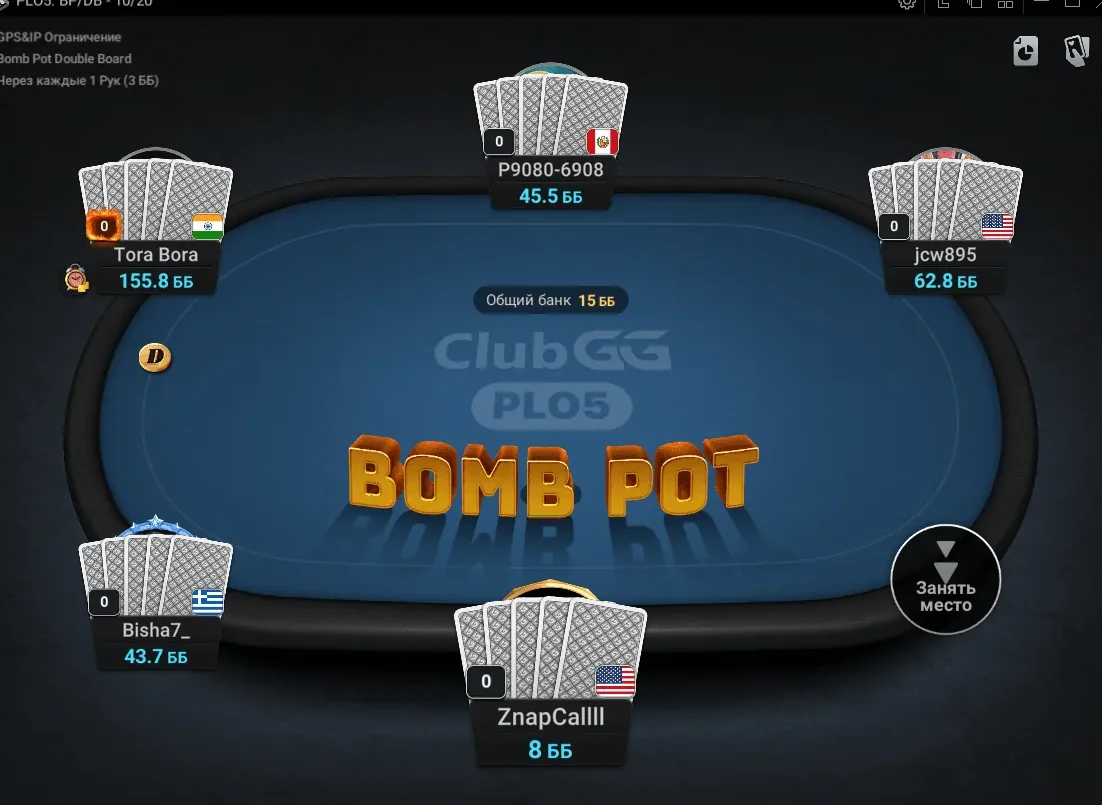
| Bomb pots | 4–6 | Everyone antes and the hand starts on the flop |
| Omaha Hi-Lo | 4 | Pot split between best high and best low |
The 2 + 3 rule never changes: with five or six cards you still use exactly two of them.
Where to play Omaha online
Omaha is the main game in several club apps, especially those popular in Latin America and Asia.
| App | Omaha games | Notes |
|---|---|---|
| Suprema Poker | PLO4 / PLO5 / PLO6 | Omaha is the app’s main strength |
| ClubGG | PLO4 / PLO5 / PLO6 | Bomb pots, double board and run it twice as table options |
| PPPoker | PLO / PLO5 | Large club network |
| PokerBros | PLO / PLO5 | Big unions, active PLO tables |
| X-Poker | PLO / PLO5 | Also known for Short Deck |
Suprema PokerReviews & guideClubGG 4.5 · 1PPPokerReviews & guidePokerBrosReviews & guideX-PokerReviews & guideTo play in a club app you join a club by ID — see the club catalog and how to join a poker club. Rake in Omaha pots can be high, so check the cap first: rake in poker apps.

Tips for Hold’em players switching to Omaha
- Before every big decision, name the two hole cards you’re playing.
- Ask “what’s the nuts?” on every street and how close you are to it.
- Don’t overvalue aces without a suit or connectivity — AA with two rags is often a one-pair hand.
- Draw to the nuts: a nut flush draw is worth far more than a king-high one.
- Expect bigger swings and keep more buy-ins — see bankroll management.
FAQ
01How many cards do you get in Omaha?
Four hole cards in standard Omaha (PLO4), five in PLO5 and six in PLO6. The board is always five cards.
02Do you have to use two cards in Omaha?
Yes — exactly two hole cards and exactly three board cards, always.
03Is it a flush with one suited card in Omaha?
No. With four of a suit on the board you still need two cards of that suit in your hand.
04What does PLO mean?
Pot-Limit Omaha: Omaha where the maximum bet or raise is the size of the pot.
05How do you calculate a pot-size raise?
Three times the last bet plus the pot before that bet. Pot 100 and a bet of 50: raise to 250.
06Are Omaha hand rankings the same as in Hold’em?
Yes. Only the 2 + 3 rule for building the hand is different.
07Which is harder, Omaha or Hold’em?
Omaha hands are harder to read and swings are bigger. Many players find it more fun because more flops are played.
08Where can I play Omaha online?
Suprema Poker and ClubGG run PLO4, PLO5 and PLO6; PPPoker, PokerBros and X-Poker run PLO and PLO5.
Read next
Download Poker for Phone and PC: Official Apps OnlyRead Poker Freerolls: What They Are, Where to Find Them and How to WinRead How to Learn Poker from Scratch: A Step-by-Step Plan and Core StrategyRead Online Poker Club: What It Is, How to Join and Choose OneRead  Play Poker Online for Free (No Download, No Sign-up?): Where to Play for Play MoneyRead Poker Hand Rankings: Chart With Pictures, From Best to Worst (2026)Read