


Poker Cards: Deck, Suits, Card Ranks and Names (2026 Guide)
Poker is played with an ordinary deck of 52 cards — but there is more to it than “just a deck”. Which card is highest, whether suits matter, what the ace can do, why online rooms paint diamonds blue and how often you’ll be dealt pocket aces: everything a beginner needs to know about poker cards, in one place.
Updated: 20 October 2026- A poker deck has 52 cards: 4 suits × 13 ranks. Jokers are removed. Short Deck uses 36 cards (the 2s to 5s are taken out).
- The four suits — spades, hearts, diamonds, clubs — are equal in Texas Hold’em and Omaha: no suit beats another.
- Card order from low to high: 2, 3, 4, 5, 6, 7, 8, 9, 10, J, Q, K, A. The ace is the highest card but also plays low in the A-2-3-4-5 straight.
- Hole cards: 2 in Hold’em, 4, 5 or 6 in Omaha, 5 in five-card draw, 7 in seven-card stud.
- Pocket pair — about 1 in 17 hands, pocket aces — 1 in 221, two suited cards — ≈23.5%.
How many cards are in a poker deck
Poker uses the standard French-suited deck: 52 cards, four suits of thirteen cards each. A new deck usually comes with one or two jokers and an advertising card — they are taken out before the game. Every popular form of poker, from Texas Hold’em to Omaha, is played with these 52 cards.
36 cards in Short Deck
The exception is Short Deck (6+ Hold’em): all twos, threes, fours and fives are removed, leaving 36 cards from six to ace. With fewer cards, flushes become rarer than full houses, and the ace can form the low straight A-6-7-8-9.
| Game | Cards in the deck | Ranks used |
|---|---|---|
| Texas Hold’em, Omaha, stud, draw | 52 | 2 to ace |
| Short Deck (6+ Hold’em) | 36 | 6 to ace |
| Some home games and draw variants | 53 | 52 + one joker |
How many players one deck can serve
In Hold’em each player gets 2 cards, the board takes 5 and the dealer burns 3. That leaves room for up to 22 players in theory, but real tables seat 9–10 at most. In Omaha with four cards the limit is 11, and in six-card Omaha only 7 — which is why PLO6 tables are usually 6-max.
Suits in poker: spades, hearts, diamonds and clubs
There are four suits in the deck: two black — spades ♠ and clubs ♣ — and two red — hearts ♥ and diamonds ♦. Each suit has the same thirteen cards from two to ace.
Do suits matter in Hold’em?
No — in Texas Hold’em and Omaha all suits are equal. A flush in spades does not beat a flush in hearts: flushes are compared by their highest cards, and if all five cards are equal, the pot is split. Suits only matter for making a flush or a straight flush.
Card ranks in poker: from two to ace
Each suit has thirteen ranks. From lowest to highest: 2, 3, 4, 5, 6, 7, 8, 9, 10, jack, queen, king, ace. A higher card beats a lower one when hands are compared by high card or kicker. In hand histories and apps the ten is written as T, so a hand like ace–ten of spades is “ATs”.
Card ranks decide the order inside every combination: a pair of kings beats a pair of queens, a jack-high straight beats a ten-high one. The full order of combinations — from high card to royal flush — is in our guide to poker hand rankings.
The ace in poker: high and low
The ace is the strongest card in the deck, but it has a special trick: in a straight it can play either high or low. High — in the top straight 10-J-Q-K-A (“Broadway”). Low — in the bottom straight A-2-3-4-5 (“the wheel”), where it counts as a one.
Pocket aces (A-A) are the best starting hand in Hold’em, and an ace in your hand gives you the strongest possible kicker. But an ace on its own is just a high card: “ace-rag” hands like A-4 offsuit lose a lot of money to better aces.
Card names: ace, king, queen, jack and the face cards
In English the cards from two to ten are called by their numbers (“deuce” for a two, “trey” for a three), and the top four by name. The jack, queen and king are the face cards (they show a person); together with the ace and ten they form the “Broadway” cards.
| Card | Symbol | English name | Russian name | Poker slang |
|---|---|---|---|---|
| A | A | Ace | Туз | Bullets; A-A — pocket rockets |
| K | K | King | Король | K-K — cowboys |
| Q | Q | Queen | Дама | Q-Q — ladies |
| J | J | Jack | Валет | J-J — hooks |
| 10 | T | Ten | Десятка | Dime |
| 2 | 2 | Two | Двойка | Deuce; 2-2 — ducks |
Some starting hands have their own nicknames: A-K is “Big Slick”, 7-2 offsuit is famous as the worst hand in Hold’em, and K-9 is sometimes called “the dog”. You don’t need them to play, but you will hear them at the table and in commentary.
Jokers in poker
Jokers are not used in Texas Hold’em, Omaha or stud. Two players can never both hold the same card, and a wild card would break the hand rankings and the odds. That is why the jokers that come with a deck are taken out.
Jokers do appear in a few variants:
- Draw poker with the “bug” — a single joker that can be used as an ace or to complete a straight or a flush.
- Some casino table games based on poker hands, played against the house with a 53-card deck.
- Home games with wild cards, where friends agree on their own rules — for example, “jokers wild” or “deuces wild”.
How many cards you get in each poker game
The number of hole cards is the main difference between poker games. In Hold’em and Omaha you combine hole cards with five community cards on the board; in draw and stud you play only your own cards.
| Game | Hole cards | Board cards | How the hand is made |
|---|---|---|---|
| Texas Hold’em | 2 | 5 | Any 5 of 7 |
| Short Deck | 2 | 5 | Any 5 of 7, 36-card deck |
| Omaha (PLO) | 4 | 5 | 2 from hand + 3 from board |
| PLO5 / PLO6 | 5 / 6 | 5 | 2 from hand + 3 from board |
| Five-card draw | 5 | — | Your 5 cards after the draw |
| Seven-card stud | 7 | — | Best 5 of your 7 |
More rules for each game: poker rules for beginners, Texas Hold’em, Omaha and Short Deck.
The four-colour deck: why online poker uses it
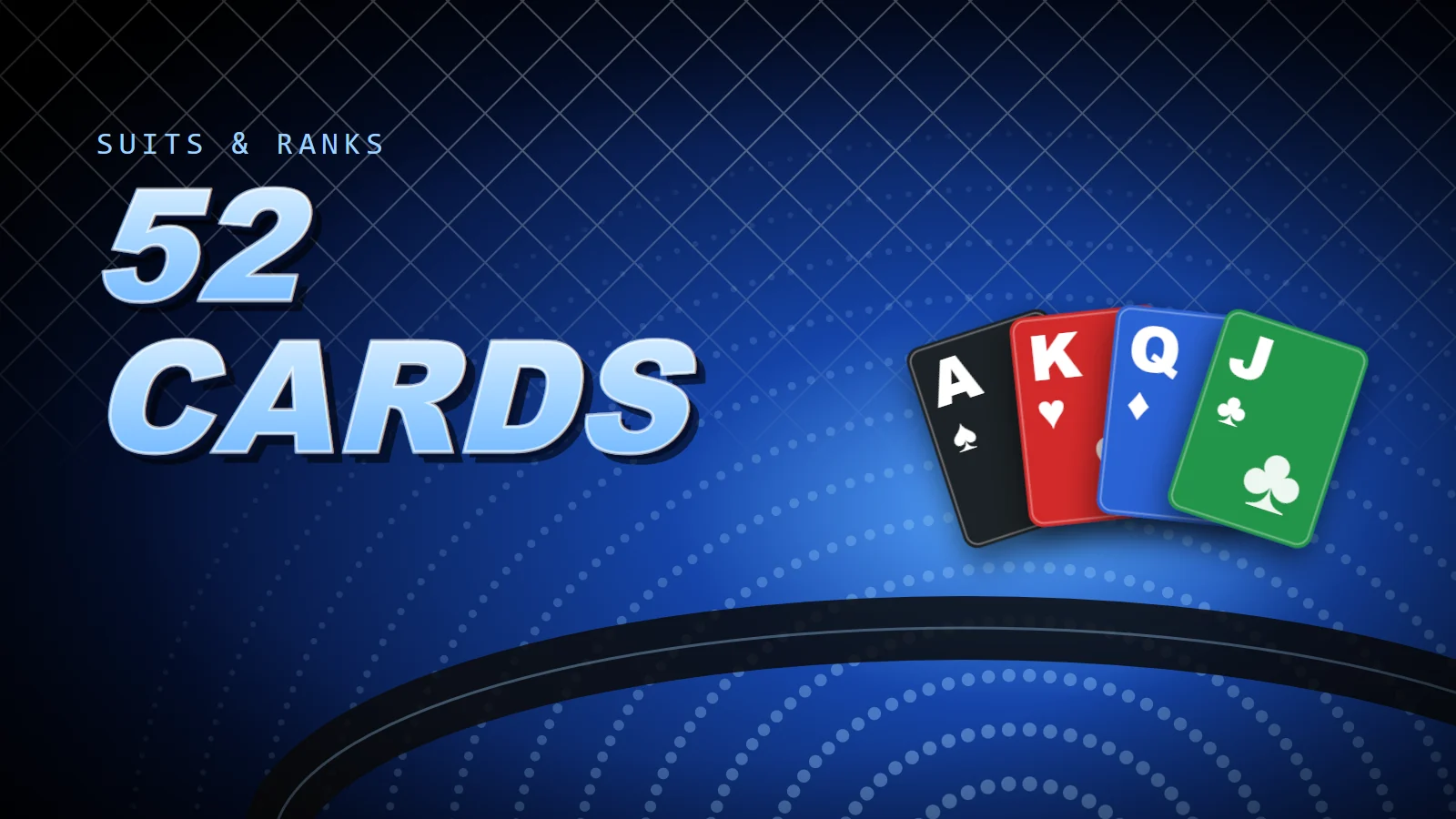
In a classic deck there are only two colours, so it’s easy to mistake a spade for a club or a heart for a diamond — and to “see” a flush that isn’t there. A four-colour deck gives every suit its own colour:
Many poker apps and rooms offer a four-colour deck in their settings, and serious players almost always turn it on: on a small phone screen and with several tables open, it noticeably cuts reading mistakes. The card images in our articles use the same scheme.
- Why players switch to four colours
- Flushes and flush draws are visible at a glance.
- Fewer misreads in Omaha, where you hold four to six cards.
- Easier to play several tables at once.
- Less eye strain in long sessions.
Playing cards for poker: size and material
Poker size vs bridge size
Cards come in two main widths. Poker size is 63.5 × 88.9 mm (2.5 × 3.5 in) — the classic shape. Bridge size is narrower, 57 × 88.9 mm (2.25 × 3.5 in). Bridge-size cards are easier to hold and hide, especially in Omaha with four or more cards, so many card rooms and tournaments use them for Hold’em and Omaha.
| Poker size | Bridge size | |
|---|---|---|
| Dimensions | 63.5 × 88.9 mm | 57 × 88.9 mm |
| Feel | Wider, classic | Narrower, easier to hold several cards |
| Typical use | Home games, many home sets | Card rooms, tournaments, Omaha |
Pay attention to the index too — the rank and suit in the corner. A large (“jumbo”) index is easy to read across the table and when you peek at your cards without lifting them.
Plastic or paper cards
For a home game it’s worth having two decks with different back colours: one is dealt while the other is shuffled, and you can quickly tell if a card from another deck slipped in. What else goes in a home poker kit — in our guide to poker chip sets.
Card odds: pocket pairs, aces and suited hands
There are 1,326 possible two-card combinations in Hold’em, which group into 169 strategically different hands: 13 pairs, 78 suited and 78 offsuit hands. That’s enough to work out how often you’ll see each type:
| What you get | Probability | About once in… |
|---|---|---|
| Any pocket pair | 5.9% | 17 hands |
| Pocket aces (A-A) | 0.45% | 221 hands |
| Any specific pair (e.g. K-K) | 0.45% | 221 hands |
| A-K, suited or offsuit | 1.2% | 83 hands |
| A-K suited | 0.3% | 332 hands |
| Two cards of the same suit | 23.5% | 4.25 hands |
| A set on the flop with a pocket pair | 11.8% | 8.5 flops |
| A flush by the river with suited cards | ≈6.4% | 16 hands seen to the river |
Among all five-card hands there are 2,598,960 combinations, and only 4 of them are royal flushes — one in 649,740.
How to shuffle and deal poker cards
A good shuffle makes the game fair. Card rooms use a fixed procedure, and it works for home games too:
- 1Wash — spread the cards face down on the table and mix them with both hands.
- 2Riffle — split the deck into two halves and riffle them together. Do it at least two or three times; mathematicians showed that about seven riffles mix a deck well.
- 3Strip (box) — take small packets from the top and place them in a new pile, then riffle once more.
- 4Cut — split the deck once and put the bottom half on top. Use a plastic cut card so the bottom card isn’t seen.
How cards are dealt in Hold’em
- Dealing rules for a home game
- The button moves one seat clockwise after each hand.
- Deal low and keep cards face down — no card should flash.
- Burn one card before the flop, the turn and the river.
- Agree in advance what happens if a card is exposed during the deal (usually a misdeal and a redeal).
- Change decks if a card is bent or marked.
Online, there is no dealer: cards are shuffled by a random number generator, and the button, blinds and dealing are automatic. That is one reason many friends now play in private clubs online instead of meeting at a table.
Poker cards online: club apps
If you want to play rather than shuffle, club apps let you play Hold’em, Omaha, Short Deck and other games with friends or in public clubs. You get the same 52-card deck — with a four-colour option, automatic dealing and hand histories. New to the game? Start with how to learn poker.
ClubGG clubs from our catalog
Ranked by player reviews; each club page lists its games, rake and rakeback. Browse all clubs in the ClubGG catalog.


FAQ
01How many cards are in a poker deck?
52 cards: four suits of 13 ranks each, without jokers. Short Deck poker uses 36 cards — the twos to fives are removed.
02Which suit is the highest in poker?
In Texas Hold’em and Omaha no suit is higher — all four are equal. Suit order (spades, hearts, diamonds, clubs from high to low) is only used for things like drawing for the button or the bring-in in stud.
03What is the highest card in poker?
The ace. It is followed by the king, queen, jack and ten. The ace can also play as the lowest card in the A-2-3-4-5 straight.
04Is there a joker in poker?
Not in Hold’em, Omaha or stud — jokers are removed from the deck. A joker is used only in some draw variants, some casino games and home games with wild cards.
05How many cards does each player get?
Two in Texas Hold’em and Short Deck, four in Omaha (five or six in PLO5 and PLO6), five in five-card draw and seven in seven-card stud.
06How often do you get pocket aces?
On average once every 221 hands (about 0.45%). Any pocket pair comes about once every 17 hands.
07What is a four-colour deck?
A deck where each suit has its own colour: spades black, hearts red, diamonds blue, clubs green. It makes flushes easier to read and is available in many poker apps.
08Which cards are best for a home game?
Plastic cards — they last much longer than paper ones. Bridge size is easier to hold, a large index is easier to read, and it helps to have two decks with different backs.
Read next
 How to Play Poker Online with Friends: Your Own ClubGG Club and a No-Rake Table (2026)Read
 Triton Poker: the Super High Roller Series Explained (2026)Read
 Poker Calculator: Free Odds, Equity, ICM and Bankroll Tools Explained (2026)Read
 Famous Poker Players: Legends, the “King of Poker” and Today’s StarsRead
 History of Poker: Where the Word Comes From, How the Game Spread and the Moneymaker EffectRead


 Poker on Android: The Best Apps and How to Play on Your PhoneRead