How Deposits and Withdrawals Work in Poker Apps (USDT, Cards, E-wallets)
Club poker apps have no deposit button. You buy chips from the club’s agent and sell them back when you cash out — by crypto, bank transfer or e-wallet, outside the app. It works smoothly in good clubs, but every step has its own trap: the chip rate, the crypto network, the fees. Here’s the whole process and what to check at each stage.
Updated: 16 October 2026
Key takeaways
ClubGG, PPPoker, PokerBros, X-Poker and Suprema have no in-app cashier: deposits and withdrawals go through the club’s agent.
Ask the chip rate first — usually 1 chip = $1, but not always.
The most common method is USDT, usually on TRC-20 or BEP-20. Sending on the wrong network can cost you the transfer.
In good clubs withdrawals take minutes to a day. Make a small test withdrawal before you build a balance.
0in-app cashiers — chips come from the agent
1:1the typical chip-to-dollar rate
$10–20a common minimum deposit in ClubGG clubs
min – 24 ha normal withdrawal time in a good club
Why there’s no cashier in club apps
Club apps officially run on chips with no cash value. The only things they sell in-app are service items: in ClubGG that’s diamonds and the WSOP+ Premium membership, paid through Google Play, the App Store or a card on PC — crypto isn’t accepted there. Club chips can’t be bought in the app at all.
Chips enter a club from the top: the owner gives credit to managers and agents, and agents sell chips to players. So your “deposit” is really a private deal with the agent: you send money, they send chips to your club balance. A cash-out is the same deal in reverse.
Yousend money to the agent
Agentconfirms the payment
Chipsappear on your club balance
Playat the club’s tables
Cash-outagent buys the chips back
How money moves in a club poker app
This is the main difference from licensed rooms like GGPoker, which have a cashier and answer for your balance. In a club, the safety of your money depends on the club and the agent — more on choosing them in what a poker agent is.
The chip rate: what you’re really playing for
Chips have no price of their own — the club sets it. At 1:1 a chip equals a dollar, so a 1/2 table means $1/$2 blinds. Some clubs use other rates or another currency. Miss this, and you can sit down at stakes several times higher than you meant to.
Chip rate
A 1/2 table means
100 chips cost
1 chip = $1
$1/$2 blinds
$100
1 chip = $0.20 (5 chips per $1)
$0.20/$0.40 blinds
$20
1 chip = $5
$5/$10 blinds
$500
These are examples of how the math works, not offers from specific clubs. Ask your agent for the exact rate and write it down before the first table.
Payment methods
Which methods you can use depends entirely on the club and your country. The agent tells you what they accept; the app has nothing to do with it.
Crypto (USDT)The most common choice: fast, no banks, works across borders. But transfers are final — check the address and network every time.
Bank transfer and cardsFamiliar and easy, but some banks block transfers linked to gambling. Ask which banks the agent accepts.
E-walletsSkrill, Neteller and local wallets — availability depends on the club and the country.
Avoid
Paying from someone else’s card, account or wallet — clubs freeze balances over third-party payments.
Paying a person the club can’t confirm as its agent.
Paying before your join request is approved.
Paying with USDT: networks and how not to lose a transfer
USDT is a dollar stablecoin that exists on several blockchains at once. The token is the same, but the networks are separate: if you send on one network and the agent’s wallet expects another, the transfer may never arrive. Agents usually name the network up front — TRC-20 or BEP-20 are the most common.
Network
Blockchain
Address looks like
What to know
TRC-20
Tron
Starts with T
Widely used for poker deposits; the fee is paid in TRX
BEP-20
BNB Smart Chain
Starts with 0x
Also common; the fee is paid in BNB
ERC-20
Ethereum
Starts with 0x
Network fees are usually higher; confirm the agent accepts it
BEP-20 and ERC-20 addresses look exactly the same. The address alone doesn’t tell you the network — always choose the network the agent named, on both sides of the transfer.
Before you press Send
The network in your wallet or exchange matches the network the agent named.
You pasted the address and checked the first and last characters against the agent’s message — malware can swap copied addresses.
Sending from a personal wallet? Keep a little of the network’s own coin (TRX, BNB or ETH) for the fee. Exchanges usually deduct the fee from the amount.
For a first payment to a new address, send a small test amount and wait for the agent to confirm.
Save the transaction hash (TXID) — it’s your receipt.
Нужен скриншотA crypto wallet’s send screen: USDT selected, the TRC-20 network chosen, the address field and the network fee
How to deposit, step by step
1
Join the club by ID with your agent’s referrer ID and wait for approval — how to join in ClubGG.
2
Message the agent: the amount and your payment method. Confirm the chip rate, the minimum deposit and any fees.
3
Get the payment details and send the money. Save the receipt or transaction hash.
4
Wait for the chips: the agent credits them to your club balance, usually within minutes. The balance shows in the club header.Нужен скриншотClubGG club lobby after a deposit: the chip balance in the club header
In ClubGG the chips you receive live only in that club — a balance in one club can’t be used in another, and a GGPoker balance can’t be moved into ClubGG. More on the specifics: deposits and withdrawals in ClubGG.
How to withdraw, step by step
1
Leave the table: chips must be on your club balance, not in play.
2
Message the agent with the amount and your payment details. For crypto, state the network along with the address.
3
The agent takes the chips off your balance — you can see it in the club’s chip history.Нужен скриншотClub chip history: the withdrawal deduction with date and amount
4
The money arrives by the chosen method. Check it and confirm receipt to the agent.
Rakeback is usually paid weekly in chips onto your balance, and you withdraw it like any other chips. How rakeback is calculated: rake in poker apps.
Timelines and fees
There’s no app-wide standard — every club sets its own terms. What matters is that you know them in advance and they don’t change after you deposit.
Ask the agent
A normal answer
How fast are withdrawals?
Within a day; large sums up to 24–48 hours
Is there a minimum withdrawal?
A specific, usually small, amount
Who pays the network or transfer fee?
Agreed in advance, no surprises
Is there a weekly withdrawal limit?
None, or a clear one written in the rules
Is the rate the same for deposits and withdrawals?
Yes, or the difference is stated up front
Warning signs
The withdrawal time keeps growing, with a new excuse each time.
A “fee” or “verification deposit” is needed before you can cash out.
The cash-out rate is suddenly worse than the deposit rate.
The agent asks you to keep playing instead of withdrawing.
The test withdrawal: the cheapest insurance
After your first session, withdraw a small amount — even if you plan to keep playing. It costs you nothing and answers the only question that matters: does this agent pay, how fast, and are the terms what they promised? Do it before your balance grows, not after.
Small depositstart below your usual stakes
First sessioncheck the tables and rules
Test withdrawala small amount
Checkspeed, fees, rate
Then play moreif it all matched
Check the agent before your balance grows
Keeping your bankroll safe
Keep on the club balance only what you plan to play this week; withdraw winnings regularly.
Pay only from accounts and wallets in your own name.
Keep every receipt, transaction hash and the chat with your agent.
Don’t leave the club or delete your account with chips on the balance — in ClubGG the balance isn’t kept after you leave.
Spread risk: if you play in several clubs, don’t keep your whole bankroll in one.





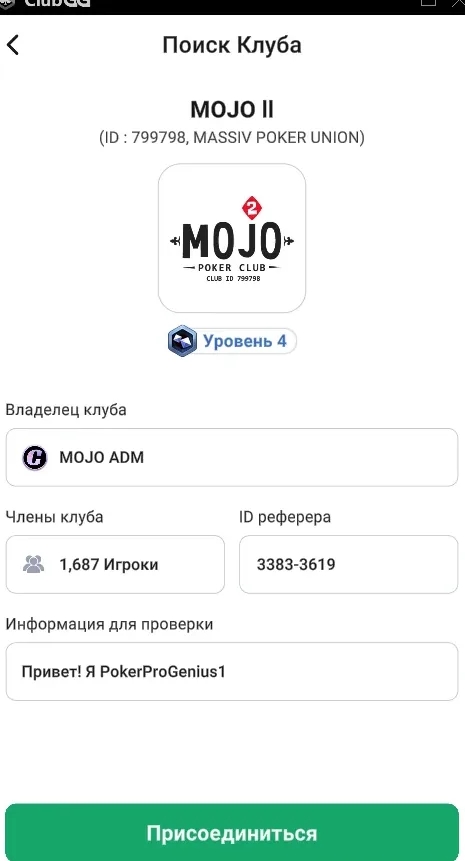
 MOJO 2 4.5 · rakeback 50% · Massive Poker Union2
 MOJO 1No reviews yet · rakeback 50% · AllinUnion3
 Mr Pink PantherNo reviews yet · rakeback 40%4
 ZerakeNo reviews yet · rakeback Zero Rake5
 POKER VIBE UANo reviews yet · rakeback 40%All clubs in the catalog
  Are Poker Apps Rigged? ClubGG, PPPoker, PokerBros and OthersRead