




Rakeback in Poker Clubs: How It Works and How to Get the Best Deal
In club poker apps rakeback isn’t a feature of the app — it’s a deal between you and your club or agent. Two players at the same table can pay very different real rake depending on what they agreed before their first deposit. Here’s how rakeback is calculated, which schemes to prefer and how to get a good deal without walking into a trap.
Updated: 16 October 2026- Rakeback is a share of the rake you paid, returned by your club or agent — not by the app.
- The cleanest scheme is a fixed % of your rake, paid regardless of whether you win or lose.
- Compare clubs by effective rake: table rake × (1 − rakeback).
- Agree the %, the formula and the payout day before you enter the agent’s referral ID and deposit.
What rakeback is and who pays it
Every pot you play is raked by the club. Rakeback is the part of that rake that comes back to you. On regular poker sites it’s a loyalty program run by the room; in club apps such as ClubGG, PPPoker, PokerBros, Suprema and X-Poker the app pays nothing — the club or your agent does, out of the rake your play generates.
That’s why the referral ID you enter when joining matters so much: it ties you to the agent who will calculate and pay your rakeback. In ClubGG you can only switch to another agent later through the club manager. More on joining — how to join a poker club.
Why clubs pay rakeback at all
Club apps are a competitive market. In a union every club offers the same tables at the same table rake, so the only way for a club or agent to stand out is the deal they give players: rakeback, bonuses, payout speed, service. Agents usually earn a share of the rake their players generate and pass part of it on — the more you play, the more room there is to negotiate.
Rakeback schemes: how it’s calculated
| Scheme | How it’s calculated | Good for | Watch out for |
|---|---|---|---|
| Fixed % of rake | Your rake × agreed % | Everyone, especially winning players | Nothing — just get the % in writing |
| Volume tiers | % depends on weekly rake bands | High-volume grinders | Tiers that are hard to reach or change without notice |
| Rake minus winnings | Based on the club’s profit from you | Losing players | Winning players can get almost nothing |
| Leaderboards / races | Ranking by hands or rake for a period | Volume players | Prizes concentrated at the top |
“Rake minus winnings”: why the formula matters
Here’s a simplified example of why two deals with the same headline number can be very different. Say in one week you paid 100 in rake and won 300 at the tables.
| Deal | How it’s counted | Your rakeback this week |
|---|---|---|
| 40% of your rake | 100 × 40% | 40 |
| 40% of “rake minus winnings” | (100 − 300) is negative | 0 |
Both deals are “40%”, but the second one pays a winning player nothing. If you expect to win, insist on a percentage of your rake. The numbers in this example are illustrative; the exact formulas vary by club — ask the agent to show you how one real week would be calculated.
Effective rake: the number to compare clubs by
The table rake tells you only half the price. What you really pay is the rake minus the rakeback:
| Club (example) | Table rake | Rakeback | Effective rake |
|---|---|---|---|
| Club A | 5% | 50% | 2.5% |
| Club B | 7% | 50% | 3.5% |
| Club C | 4% | 0% | 4% |
| Club D | 6% | 40% | 3.6% |
Don’t forget the cap: at higher stakes most pots hit it, and a low cap can matter more than the percentage. The full picture is in rake in poker apps.
Payout schedule: when and how rakeback arrives
Most clubs pay rakeback weekly, in chips, credited to your club balance. A good club pays on a fixed day without reminders. Before agreeing, make sure you know:
- The payout day and the period it covers — for example Monday to Sunday.
- Whether there’s a minimum volume to qualify.
- Whether rakeback chips can be withdrawn right away or must be played first.
- Where you can see your rake for the week — a statement from the agent or the club’s records.
- What happens to unpaid rakeback if you switch clubs or agents.
How to negotiate a better deal
- 1Talk before you join. Once your referral ID is set, you have less leverage — switching agents goes through the club manager.
- 2Tell the agent your stakes and expected volume. Agents earn from your rake, so regular volume is your best argument.
- 3Compare two or three offers in the same union — the table rake is identical, so the deal is all that differs.
- 4Ask for the formula in writing: % of your rake, the payout day and any minimum volume.
- 5Start small and check the first payout. If it arrives on time and matches the formula, scale up.
Red flags in rakeback offers
- The agent can’t explain how rakeback is calculated.
- The deal is “discussed later” or changes after your deposit.
- Rakeback is only paid when you lose.
- An unusually high % combined with high table rake and no cap.
- Withdrawals are blocked until you “play through” the rakeback.
- Pressure to deposit fast to “lock in” a deal.
An agent who delays rakeback often delays withdrawals too. If payments stop, see what to do when a club freezes your balance.
Rakeback in the main club apps
| App | Who pays | What we know |
|---|---|---|
| ClubGG | Club or agent | Clubs in our catalog pay 40–50% with 5–7% table rake; short-handed tables are discounted automatically |
| PPPoker | Clubs and agents | Big unions also run rake races and jackpots |
| PokerBros | Clubs and agents | Large unions run rake races and leaderboards |
| Suprema Poker | Clubs and agents | Unions run jackpots and rake races |
| X-Poker | Agents | Rakeback via agents; terms vary by club |
ClubGG 4.5 · 1PPPokerReviews & guidePokerBrosReviews & guideSuprema PokerReviews & guideX-PokerReviews & guideRakeback is the main value in club poker, but not the only one. Leaderboards, freerolls and deposit bonuses are covered in poker club bonuses; everything else you pay — in all the fees in poker apps.
ClubGG clubs with high rakeback
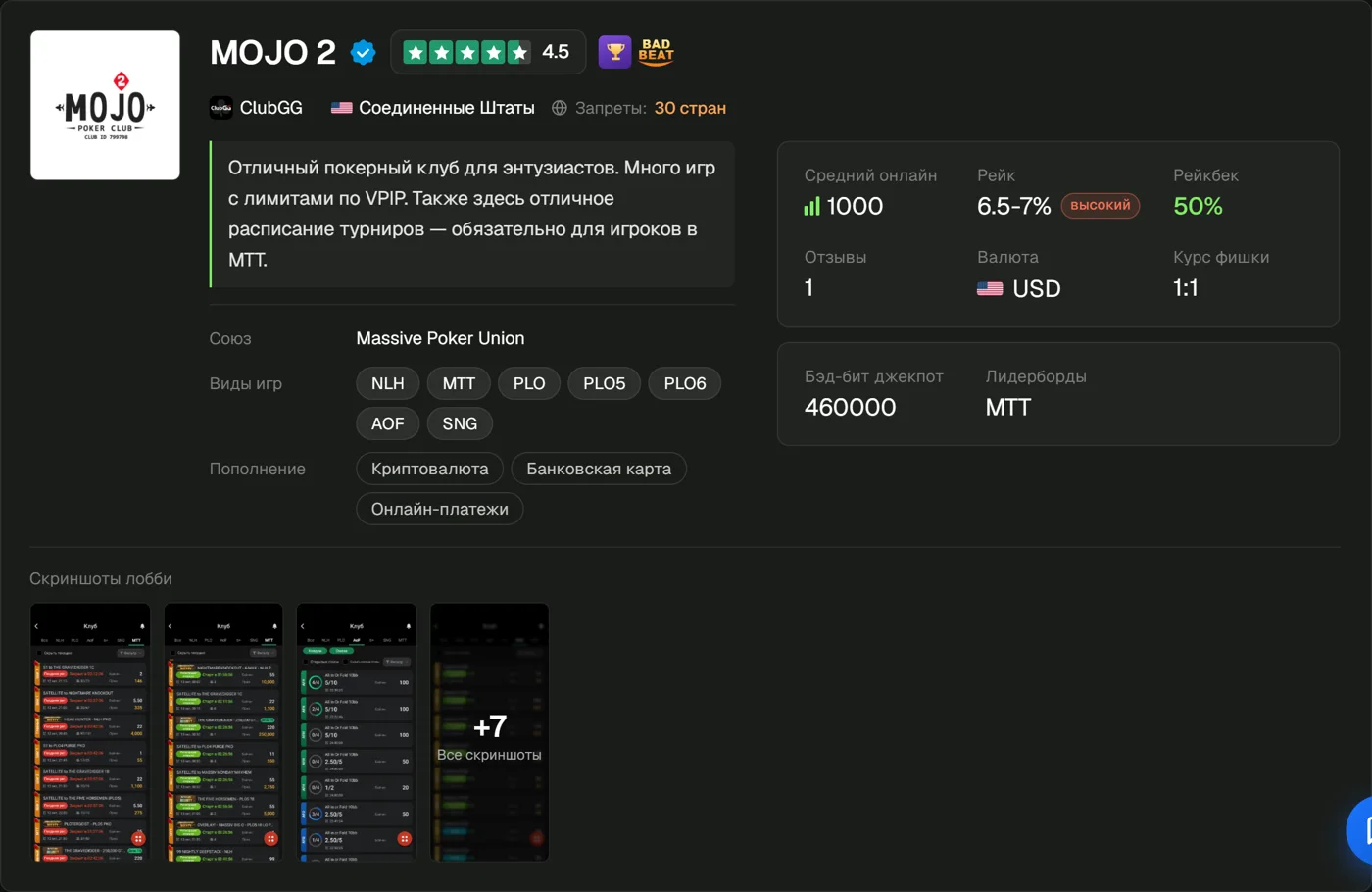
These clubs are ranked by player reviews. Check each club page for the rake and rakeback, then confirm the formula with the agent.
 MOJO 2 4.5 · rakeback 50% · Massive Poker Union2
 MOJO 1No reviews yet · rakeback 50% · AllinUnion3
 Mr Pink PantherNo reviews yet · rakeback 40%4
 ZerakeNo reviews yet · rakeback Zero Rake5
 POKER VIBE UANo reviews yet · rakeback 40%All clubs in the catalog
 FAQ
01What is rakeback in poker clubs?
A share of the rake you paid that your club or agent returns to you, usually weekly in chips. The app itself doesn’t pay it.
02What is a good rakeback percentage?
It depends on the table rake. In our catalog ClubGG clubs pay 40–50% with 5–7% rake. Compare clubs by effective rake, not by the rakeback number alone.
03Do I get rakeback if I win?
With a fixed % of your rake — yes. With “rake minus winnings” schemes you may get little or nothing when you win, so ask for the exact formula.
04How often is rakeback paid?
Most often weekly, in chips on your club balance. Agree the payout day before your first deposit.
05Can I change my agent to get better rakeback?
In ClubGG only through the club manager, who can move you to another agent. That’s why it’s best to negotiate before you enter the referral ID.
Read next
All-in or Fold (AoF) Poker: Rules and Push/Fold Strategy (2026)Read  Are Poker Apps Rigged? ClubGG, PPPoker, PokerBros and OthersRead Best Poker Apps for Low Stakes and Beginners (2026)Read Best Club Poker Apps in 2026: Ranked by Player ReviewsRead Bomb Pot Poker: Rules, Strategy and Where to Play (2026)Read ClubGG vs PPPoker vs PokerBros: Which Club Poker App to Choose (2026)Read