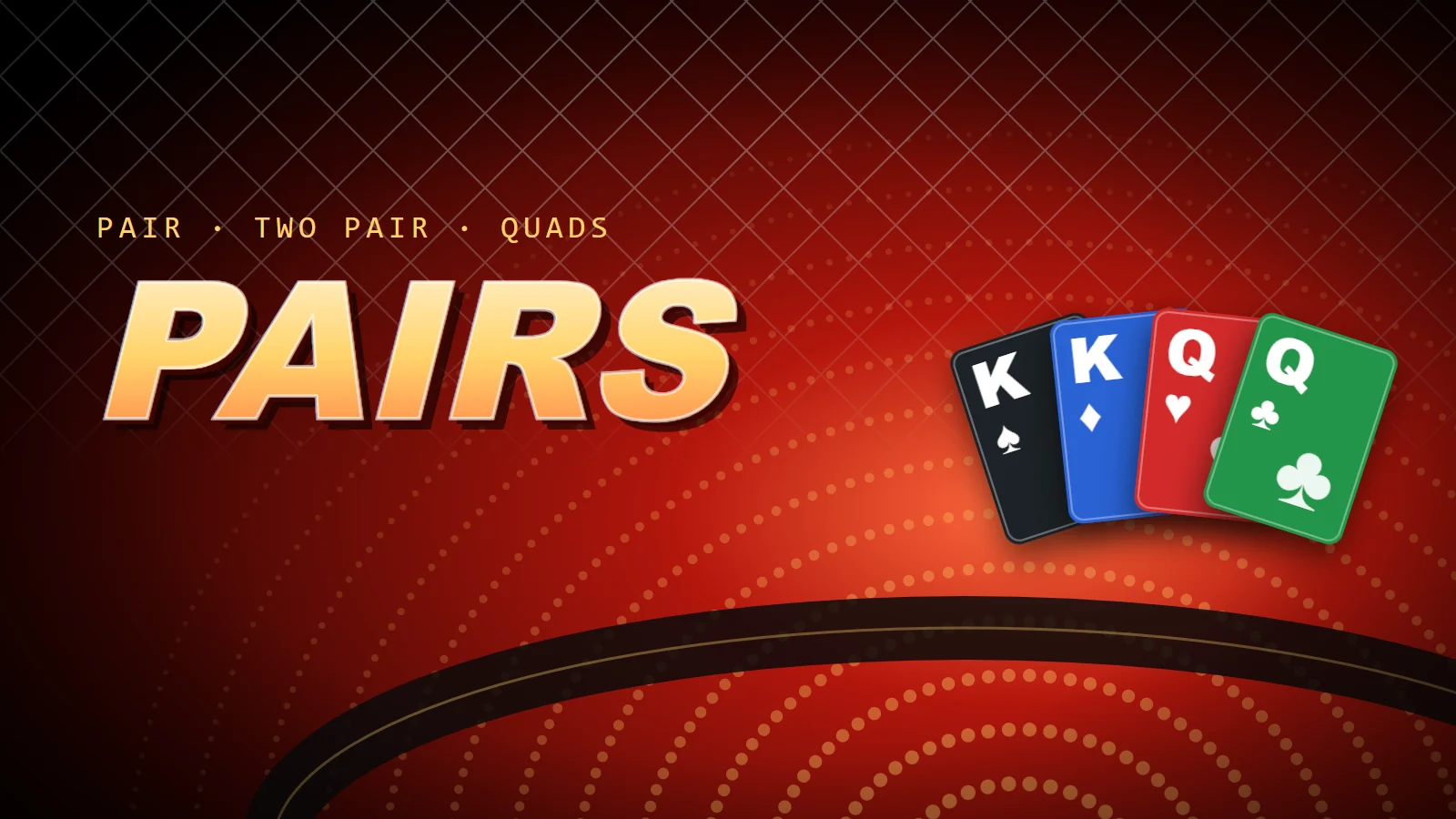



Pairs in Poker: One Pair, Two Pair, Trips, Full House and Quads
Most pots in Hold’em are won with a pair or a hand built from pairs. Knowing exactly how one pair, two pair, three of a kind, a full house and quads compare — and when the kicker or the board decides — is what separates a correct showdown read from a costly call. Here are the rules, the tricky board situations and the numbers.
Updated: 20 October 2026- Five hands are built on cards of the same rank: one pair, two pair, three of a kind, full house and four of a kind (quads).
- One pair is compared by the pair’s rank first, then by the three kickers; two pair — top pair, then second pair, then the kicker.
- A full house is decided by the three of a kind; quads by their rank and then the fifth card.
- When the board pairs, your two pair can be counterfeited and everyone may end up playing the board for a split pot.
- One pair is a decent hand in heads-up Hold’em, often just a bluff-catcher multiway and usually weak in Omaha.
The strongest poker hands and where the pairs sit
Poker has ten hand ranks. Half of them are built from cards of the same rank — pairs and their “bigger brothers”. Here is a quick reminder of the full order, from the strongest hand down; the full guide with examples is in poker hand rankings.
| # | Hand | Example | Built on pairs? |
|---|---|---|---|
| 1 | Royal flush | A♠ K♠ Q♠ J♠ 10♠ | No |
| 2 | Straight flush | 9♥ 8♥ 7♥ 6♥ 5♥ | No |
| 3 | Four of a kind | Q♣ Q♦ Q♥ Q♠ 7♦ | Yes — four of one rank |
| 4 | Full house | K♥ K♦ K♠ 4♣ 4♥ | Yes — three plus a pair |
| 5 | Flush | A♦ J♦ 8♦ 6♦ 3♦ | No — see flush in poker |
| 6 | Straight | 10♣ 9♦ 8♠ 7♥ 6♣ | No — see straight in poker |
| 7 | Three of a kind | 7♠ 7♥ 7♦ K♣ 2♠ | Yes — three of one rank |
| 8 | Two pair | J♠ J♦ 5♣ 5♥ A♦ | Yes — two different pairs |
| 9 | One pair | A♠ A♦ K♣ 9♥ 4♠ | Yes — two of one rank |
| 10 | High card | A♣ Q♦ 9♠ 6♥ 3♣ | No |
One pair: rank first, then kickers
One pair is two cards of the same rank plus three unrelated cards. When two players have one pair, compare in this order:
- 1The rank of the pair: aces beat kings, kings beat queens, and so on down to deuces. A pair of twos beats any hand without a pair.
- 2If the pairs are equal, the highest kicker decides.
- 3If those are equal too — the second kicker, then the third.
- 4If all five cards match by rank, the pot is split.
When the pair is the same: the kicker decides
This is where the ace matters most. An ace kicker is the best possible kicker, and a pair of aces is the strongest pair. That is why hands like A-K and A-Q are so valuable in Hold’em — and why A-x with a small second card is a trap: when you pair your ace, anyone with a better ace has you beaten.
Two pair: top pair, second pair, kicker
Two pair is two cards of one rank, two of another and one kicker. It is named after the higher pair: J-J-5-5-A is “jacks up” or “jacks and fives”. Compare two pair hands in three steps: the higher pair, then the lower pair, then the kicker.
Three pairs: only the best two count
In Hold’em seven cards can contain three pairs. Only the two highest play, and the fifth card is the best remaining one — sometimes a card from the third pair.
Same two pairs: the kicker
Three of a kind: set vs trips
Three of a kind is three cards of one rank plus two kickers. In Hold’em the same hand has two names depending on how you made it — the rank is identical, but the way it plays is very different.
| Set | Trips | |
|---|---|---|
| How it’s made | Pocket pair + one matching card on the board | One card in hand + a pair on the board |
| Example | 8♥ 8♣ on 8♦ K♠ 3♣ | K♥ Q♦ on K♠ K♣ 5♥ |
| Disguise | Hidden — the board shows no pair | Visible — everyone sees the paired board |
| Kicker problems | Almost never | Often: another player may hold the same card with a better kicker |
| Value | Usually wins big pots | Strong, but proceed carefully against big action |
Two three-of-a-kinds are compared by rank first (queens beat jacks), then by the first kicker and the second. With trips, the kicker is the whole battle — another reason why ace-high hands are worth more.
Full house: the three of a kind decides
A full house is three of a kind plus a pair: Q-Q-Q-7-7 is “queens full of sevens”. There are no kickers — all five cards are already used. Compare two full houses by the rank of the three first; only if those are equal (possible with a pair or trips on the board) does the pair decide.
Full house on the board
Four of a kind (quads)
Four of a kind is all four cards of one rank plus a kicker. It beats a full house and a flush and loses only to a straight flush and a royal flush. Two quads are compared by rank; if the quads are the same — which only happens when all four are on the board — the fifth card decides.
Quads on the board: the kicker wins
Quads over quads
Pocket pairs and board pairs: overpair, top pair, underpair
In Hold’em a pair is described by where it sits relative to the board. These terms are used in every hand discussion — the full glossary is in poker terms.
| Term | Meaning | Typical strength |
|---|---|---|
| Pocket pair | Two hole cards of the same rank (dealt 1 in 17 hands) | Depends on rank and board |
| Board pair | A pair among the community cards — shared by everyone | Worth nothing on its own |
| Overpair | Pocket pair above all board cards | Strong one-pair hand |
| Top pair | Hole card matches the highest board card | Good heads-up; kicker matters |
| Middle / second pair | Matches the second board card | Showdown value, rarely more |
| Bottom pair | Matches the lowest board card | Weak |
| Underpair | Pocket pair below all board cards | Weak; mostly hoping for a set |
Which pocket pairs are worth playing before the flop, and from which position, is covered in poker starting hands.
Paired boards: playing the board and split pots
When the board itself holds a pair or two, everyone shares it. Your hole cards only matter if they improve on the five board cards. If they don’t, you are “playing the board” — and so may your opponent, which means a split pot.
- Quick read on a paired board
- Write down the best five cards using the board alone — that is the minimum everyone has.
- Check whether one of your cards makes three of a kind or a full house with the board pair.
- Check whether your pocket pair is higher than the lower board pair — then it replaces it.
- Check whether your highest card beats the board’s kicker; if not, you are playing the board.
In Hold’em you may use two, one or none of your hole cards — see Texas Hold’em rules. In Omaha you can never play the board: exactly two hole cards and three board cards are always used.
Counterfeiting: when the board kills your two pair
Your hand is counterfeited when a board card makes your own cards useless. The classic case: you flop two pair with small cards, then the board pairs higher than your lower pair. Now the board’s pair plays instead, and anyone with a single bigger pair beats you.
| Situation | What happens |
|---|---|
| Small two pair, board pairs higher (Q-4-3 → 7-7) | Your lower pair is replaced by the board pair; any bigger pair beats you |
| Pocket pair 5-5, board runs 9-9-K-K | K-K-9-9 plays from the board, your fives are only a kicker — any card above five beats you |
| Top pair with weak kicker, two overcards fall | Board cards outrank your kicker — you may be playing the board |
| Low straight or two pair, board makes a better hand | Everyone shares the board hand — expect a split or a loss |
How strong is one pair in Hold’em and Omaha
With seven cards in Hold’em, roughly 79% of hands contain at least one pair — so “I have a pair” means little on its own. How much a pair is worth depends on the game, the number of opponents and the board.
| Texas Hold’em | Omaha (PLO) | |
|---|---|---|
| Hole cards | 2 | 4 (5–6 in PLO5/PLO6) |
| Chance of a pocket pair | ≈ 5.9% (1 in 17) | ≈ 32% of 4-card hands contain a pair |
| Can you play the board | Yes | No — always 2 from hand + 3 from board |
| Board quads 8-8-8-8 | Everyone has quads, kicker decides | You can use only three eights — at best a full house |
| Top pair top kicker | Often the best hand heads-up | Usually a marginal hand |
| Hands that win big pots | Two pair, sets, straights | Nut straights, nut flushes, full houses |
More on how hands play with four hole cards in our Omaha rules guide.
Odds of pairs and pair-based hands
5-card hands
| Hand | Combinations | Probability | Odds |
|---|---|---|---|
| One pair | 1,098,240 | ≈ 42.3% | ≈ 1 in 2.4 |
| Two pair | 123,552 | ≈ 4.75% | ≈ 1 in 21 |
| Three of a kind | 54,912 | ≈ 2.11% | ≈ 1 in 47 |
| Full house | 3,744 | ≈ 0.144% | ≈ 1 in 694 |
| Four of a kind | 624 | ≈ 0.024% | ≈ 1 in 4,165 |
Best 5 of 7 cards (Texas Hold’em by the river)
| Hand | Probability |
|---|---|
| One pair | ≈ 43.8% |
| Two pair | ≈ 23.5% |
| Three of a kind | ≈ 4.8% |
| Full house | ≈ 2.6% |
| Four of a kind | ≈ 0.17% |
Hold’em situations
| Situation | Chance |
|---|---|
| Being dealt any pocket pair | ≈ 5.9% (1 in 17) |
| Being dealt one specific pair, e.g. A-A | ≈ 0.45% (1 in 221) |
| Pocket pair flops a set or better | ≈ 11.8% (about 1 in 8.5) |
| Pocket pair makes a set or better by the river | ≈ 19.2% |
| Unpaired hand pairs at least one hole card on the flop | ≈ 32% |
| Unpaired hand flops two pair with both hole cards | ≈ 2% |
| Set on the flop improves to a full house or quads by the river | ≈ 33% |
| Two pair on the flop improves to a full house by the river | ≈ 16.5% |
| Pocket pair makes quads by the river | ≈ 0.8% |
Want the exact numbers for your own hand against a range? Plug it into our equity calculator.
Playing top pair: kicker problems and ace kickers
Top pair is the hand you will hold most often after the flop — and the one that loses the most money when played badly. The main danger is the kicker: two players with the same top pair, and the one with the worse kicker is drawing to just three outs.
Dominated hands are expensive: A-K against A-Q before the flop has roughly 70–75% equity, and on an ace-high flop A-Q has about 13% to catch up. When you pair an ace with a small kicker and meet heavy resistance, you are often against a better ace.
- 1Check your kicker: top pair with an ace or king kicker is a value hand; with a small kicker it is a pot-control hand.
- 2Count opponents: heads-up you can bet for value on several streets; multiway, keep the pot smaller.
- 3Read the board: flush and straight draws, or a paired board, reduce the value of one pair.
- 4Watch the turn and river: an overcard, a third suited card or a board pair can turn top pair into a bluff-catcher.
- 5Respect big raises: a raise against your bet on a dry board from a cautious player usually means two pair or better.
- Mistakes that cost money with pairs
- Stacking off with top pair, weak kicker in a multiway pot.
- Overvaluing an overpair when the board brings four to a straight or a flush.
- Ignoring a paired board and calling with two pair that has been counterfeited.
- Thinking that a third card of your lower rank makes a better full house.
- Playing one pair in Omaha like you would in Hold’em.
Practice in ClubGG clubs
Reading pairs, kickers and paired boards becomes automatic with volume. These ClubGG clubs from our catalog are ranked by player reviews; each club page lists games, rake and rakeback.




FAQ
01Which is higher in poker, two pair or three of a kind?
Three of a kind beats two pair. Any trips — even 2-2-2 — beats A-A-K-K.
02How do you decide between two players with the same pair?
By the kickers: compare the highest unpaired card first, then the second and the third. If all five cards match by rank, the pot is split.
03What decides between two full houses?
The three of a kind. Q-Q-Q-2-2 beats J-J-J-A-A. The pair matters only when the threes are equal, which can happen when the board has three of a kind.
04What is the difference between a set and trips?
Both are three of a kind. A set is a pocket pair plus one matching board card; trips is one hole card plus a pair on the board. A set is better hidden and has fewer kicker problems.
05Can four of a kind lose?
Yes — to a straight flush, a royal flush or a higher four of a kind. With quads on the board, the player with the best fifth card wins.
06What does counterfeiting mean in poker?
A board card makes your hand worse relative to others: for example, the board pairs above your lower pair, so your two pair is no longer the best two pairs available.
07How often do you get a pocket pair?
About once every 17 hands (≈5.9%). A specific pair, like aces, comes once in 221 hands.
08Is one pair a good hand?
In heads-up Hold’em, top pair with a good kicker or an overpair often wins. Multiway and in Omaha one pair is usually weak.
Read next
 How to Play Poker Online with Friends: Your Own ClubGG Club and a No-Rake Table (2026)Read
 Triton Poker: the Super High Roller Series Explained (2026)Read
 Poker Calculator: Free Odds, Equity, ICM and Bankroll Tools Explained (2026)Read
 Famous Poker Players: Legends, the “King of Poker” and Today’s StarsRead
 History of Poker: Where the Word Comes From, How the Game Spread and the Moneymaker EffectRead

 Poker on Android: The Best Apps and How to Play on Your PhoneRead