Time bank, blinds and buy-in
Time bank, blinds, ante, straddle and buy-in: how to choose stakes, work out the buy-in in big blinds and whether you need buy-in authorization.
The next block of settings decides what stakes the table plays and what stack a player sits down with. These are the most important numbers on the table: a player looks at the stakes and the buy-in to decide whether the table is for them before they ever sit down.
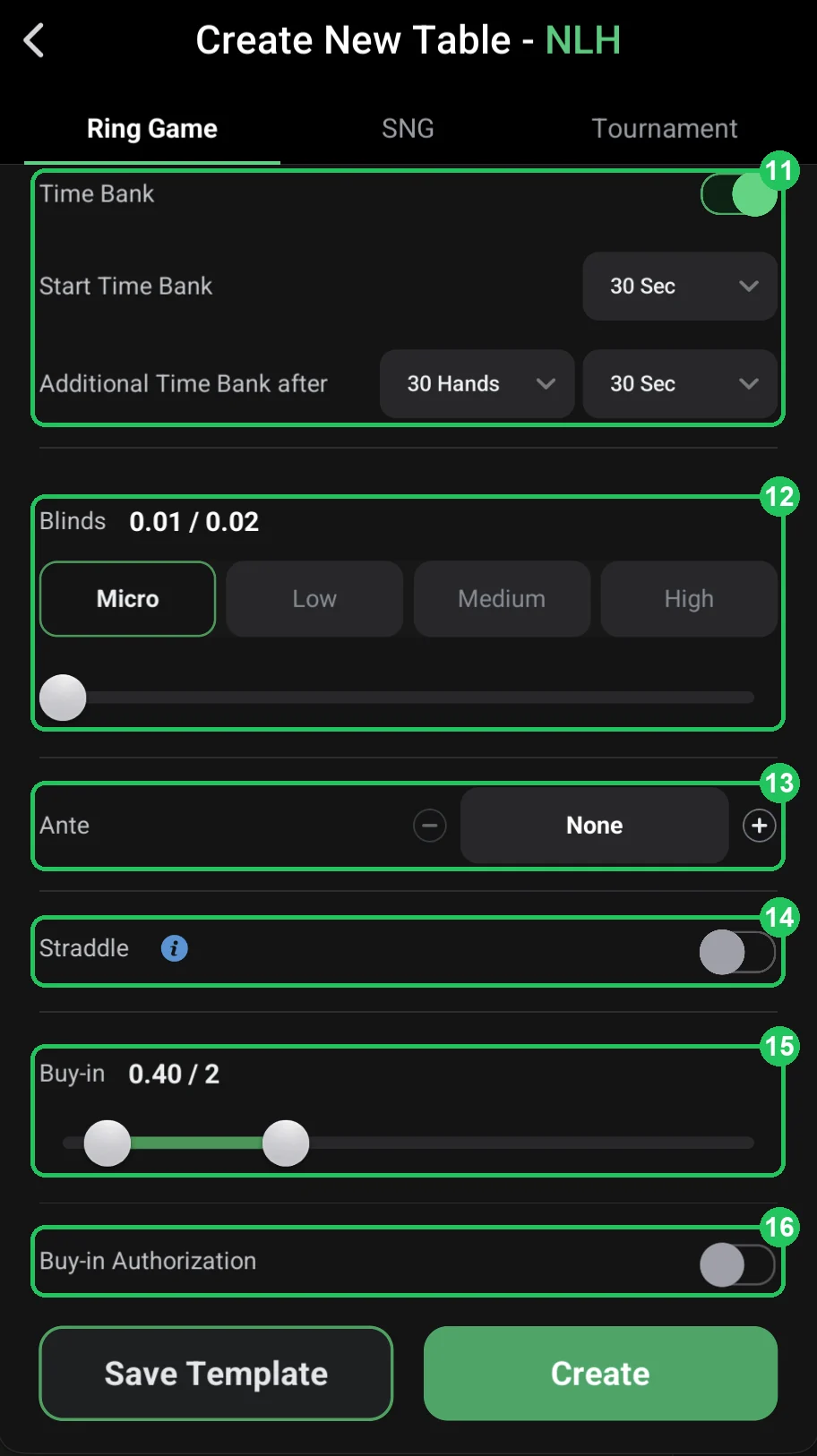
Blinds (12) set the stakes: the small and big blind, e.g. 0.01/0.02. ClubGG has Micro / Low / Medium / High presets and a slider for fine-tuning. Start low: it’s easier to gather your first players, and a beginner is more relaxed sitting down when an evening can’t cost much. Moving up is easy (open a second table); persuading people to play above their usual stakes is hard. Remember that stakes are in club chips: what one chip is worth is up to you when you agree on deposits with players.
Buy-in (15) is the minimum and maximum amount a player can sit down with. It’s easiest to think of it in big blinds (BB): divide the amount by the big blind. At 0.01/0.02 blinds, a buy-in from 0.40 to 2 is 20 to 100 BB (0.40 / 0.02 = 20, 2 / 0.02 = 100). The cash-game standard is a 100 BB maximum with a 40–50 BB minimum. Too small a minimum (20 BB or less) lets players sit down short-stacked and play pure shove-or-fold, which regulars dislike.
The Time Bank (11) is extra time on top of the normal action time. It’s for tough decisions — say, a river in a big pot: the player can think longer without slowing down every hand. Ante (13) and straddle (14) make pots bigger and the game more aggressive; they’re usually left off on a first table. An ante makes sense on a separate action table, and a straddle if your players are used to it from live games.
Buy-in Authorization (16) makes an admin approve every buy-in. It protects clubs where chips are given on credit or where you want control over who sits down and for how much. But if no admin is online the player has to wait for approval — so in a normal club, where chips are only issued after payment, it’s usually left off.
Time, blinds and buy-in (screenshot 1)
- 11 — Time Bank: extra time for tough decisions — a starting bank (Start Time Bank) plus top-ups every N hands. Recommendation: on; the default amount is fine for a first table.
- 12 — Blinds: the table stakes. Micro / Low / Medium / High presets and a slider — e.g. 0.01/0.02. Recommendation: start with Micro or Low.
- 13 — Ante: an ante from every player, off by default. Recommendation: no ante.
- 14 — Straddle: allow a straddle — a voluntary blind raise before the deal (usually 2 BB). Recommendation: off unless players ask for it.
- 15 — Buy-in: minimum and maximum buy-in. 0.40 / 2 at 0.01/0.02 blinds is 20–100 big blinds. Recommendation: 40–100 BB or 50–100 BB — the cash-game standard.
- 16 — Buy-in Authorization: every buy-in must be approved by a club admin. Recommendation: off if chips are only issued after payment; on if you want manual control over who sits down.
Recommended stakes and buy-ins for your first table
- 0.01/0.02 — buy-in 0.80–2 (40–100 BB) or 1–2 (50–100 BB).
- 0.02/0.05 — buy-in 2–5 (40–100 BB) or 2.50–5 (50–100 BB).
- 0.05/0.10 — buy-in 4–10 (40–100 BB) or 5–10 (50–100 BB).
- Formula: buy-in in BB = amount ÷ big blind. A 100 BB maximum is the standard players expect.
- A deep table (200 BB maximum) is a separate format for deep-stack fans; you don’t need it on a first table.